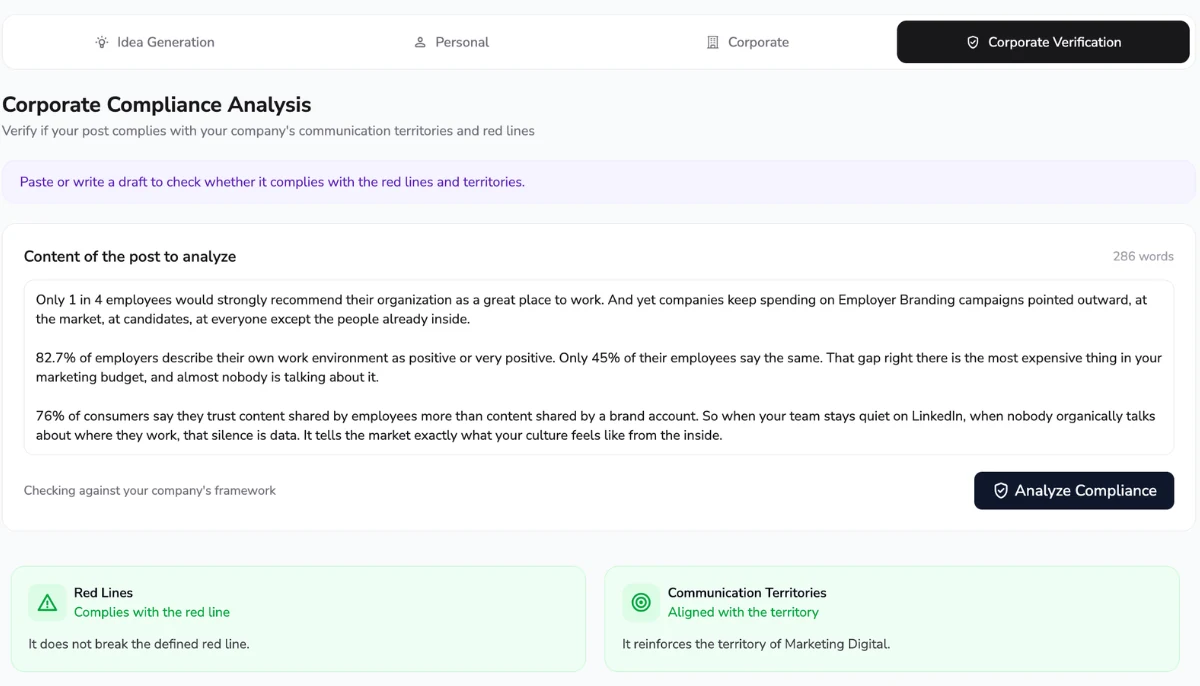
Define your company's communication framework and let any professional check their content before publishing it, in seconds and from their work email.
This isn't a discipline problem. It's a framework problem: we ask our professionals to show up, and we give them no reference at all for where the line sits.
On LinkedIn, personal wins: the routine, the trip, the project that went well, the team. That's why it's recommended, why it's taught, and why every year your professionals share more.
Routines, travel, client names, live projects, locations and internal structure. Preparing a targeted attack doesn't require breaking into anything: reading is enough.
Almost every company has its social media policy in a PDF. Almost none can say how many people applied it this month.
A document signed during onboarding and never opened again. It can't be measured, it can't be demonstrated, and it helps nobody at the moment it actually matters: right before hitting publish.
The same policy turned into territories and red lines the system understands. Any professional checks their content in seconds, and Communications sees aggregate use of the framework, not individual people.
The professional pastes their draft, or uploads the image that goes with it, and gets a verdict written to help them. Green, publish. Amber, there's one specific point to review. Red, better to check with Communications. None of them blocks anything: the decision is always theirs.

The professional gets the recommendation, never the rulebook. Red lines and territories are visible to the administrator alone, because a company's communication framework is sensitive information.
It's the same product, but each one buys it for a different reason.
Message coherence without slowing your professionals down. You know which subjects are being covered and can support whoever needs it, instead of finding out once it's already published.
A smaller exposure surface for social engineering. Information about clients, projects, locations and internal structure passes through a judgement call before it becomes public.
A social media policy you can demonstrate and audit. You stop having a signed document and start having an applied framework, with an aggregate record of its use.
This matters enough that we'd rather say it on the page itself than bury it in the small print. If your works council reads this as monitoring, the rollout fails. That's why it was designed this way from the start.
Scoringmy is offered as a third-party application and is not endorsed or backed by LinkedIn. It does not scrape or automate users' behaviour.
A one-off payment to build the framework and a fee for the tool across your whole workforce. The full breakdown, with the five bands by company size, is on the pricing page.
Prices exclude VAT · Automatic renewal that you can cancel whenever you want · It's an independent service: you don't need analytics or the ambassador programme to have it.
You can buy it on its own, with no analytics and no ambassador programme. It's the first step and the easiest one to take: it touches nobody, it needs nothing from IT and it's bought with a risk budget rather than a marketing one.
Checking is always included for your ambassadors. With an active programme from 5 ambassadors, the monthly fee for your whole workforce drops by 50%. And once you reach 100 ambassadors or 5% of the workforce, whichever is greater, both the fee and the €2,900 set-up become included at no cost.
The questions that always come up in the first meeting, with Communications, with Security and with the works council.
No. It's a voluntary tool that helps the professional. The company cannot see drafts that aren't checked, receives no named alerts, and the panel shows aggregate data: volume of checks, recurring themes and activity by area. There is no tracking of anyone's LinkedIn activity inside this tool, and no data that could be used for disciplinary purposes.
Nothing. Use is voluntary, and the company can't even know what wasn't checked, because it has no access to drafts. The value of the system is that checking is fast and unintrusive enough to be worth doing, not that anyone is forced into it.
That it's a tool that helps and that using it is voluntary, that the company never sees drafts, that no text is stored and that panel data is aggregated and can't be used to single anyone out. Our advice is to present it before rolling it out rather than after: the conversation is far easier when it's explained as support rather than as a new rule.
Usually security or compliance, because what's being bought is risk reduction, not reach. That's a meaningful difference from the ambassador programme, which is funded from marketing or HR. Many companies start here precisely because the budget is different and the decision doesn't depend on a marketing committee.
The framework definition session takes 90 minutes and we arrive with a pre-built proposal for your sector, so you're working on something rather than a blank page. After that there's the configuration and loading the list of work emails. There's no development, no integration and nothing deployed on anyone's machine.
No, and it doesn't try to. It doesn't analyse traffic, email or devices, and it doesn't detect threats. It deals with something far more specific that nobody covers today: the information your own workforce publishes voluntarily on LinkedIn, which is the raw material for social engineering. It's a complementary layer, not a replacement.
Thirty minutes to see it working on a real post, with a draft framework for your sector.