Employee Advocacy and Employer Branding: How to Attract Talent Through Your Employees’ Voices on LinkedIn
Many companies still try to attract talent on LinkedIn with an almost exclusively corporate-page logic.
They post job openings. They share internal news. They talk about culture. They show events, awards, or employer branding initiatives.
All of that adds value.
But it usually isn’t enough.
The reason is fairly simple: candidates don’t evaluate a company only by what the company says about itself.
They evaluate it, above all, by what they perceive in the people who work inside.
That’s where two concepts many companies still work on separately intersect: employee advocacy and employer branding.
When they connect well, the effect is far more powerful.
Employer branding provides direction, narrative, and an employer value proposition.
Employee advocacy provides credibility, closeness, and human visibility.
One organizes the message. The other brings it to life.
And on LinkedIn that combination can make an enormous difference.
At Scoringmy this crossover makes a lot of sense, because the platform doesn’t stop at encouraging people to post. First it measures what’s happening in the organization. Then it detects which professionals have the most visibility potential. Then it helps activate them with data, AI, challenges, and content adapted to their style. And it also lets you understand which departments, profiles, or groups can do most to reinforce talent attraction through more credible communication.
In this article we’ll look at how employee advocacy and employer branding relate, why this union matters more and more on LinkedIn, which mistakes to avoid, and how a company can build a stronger talent attraction strategy from the real voices of its professionals.
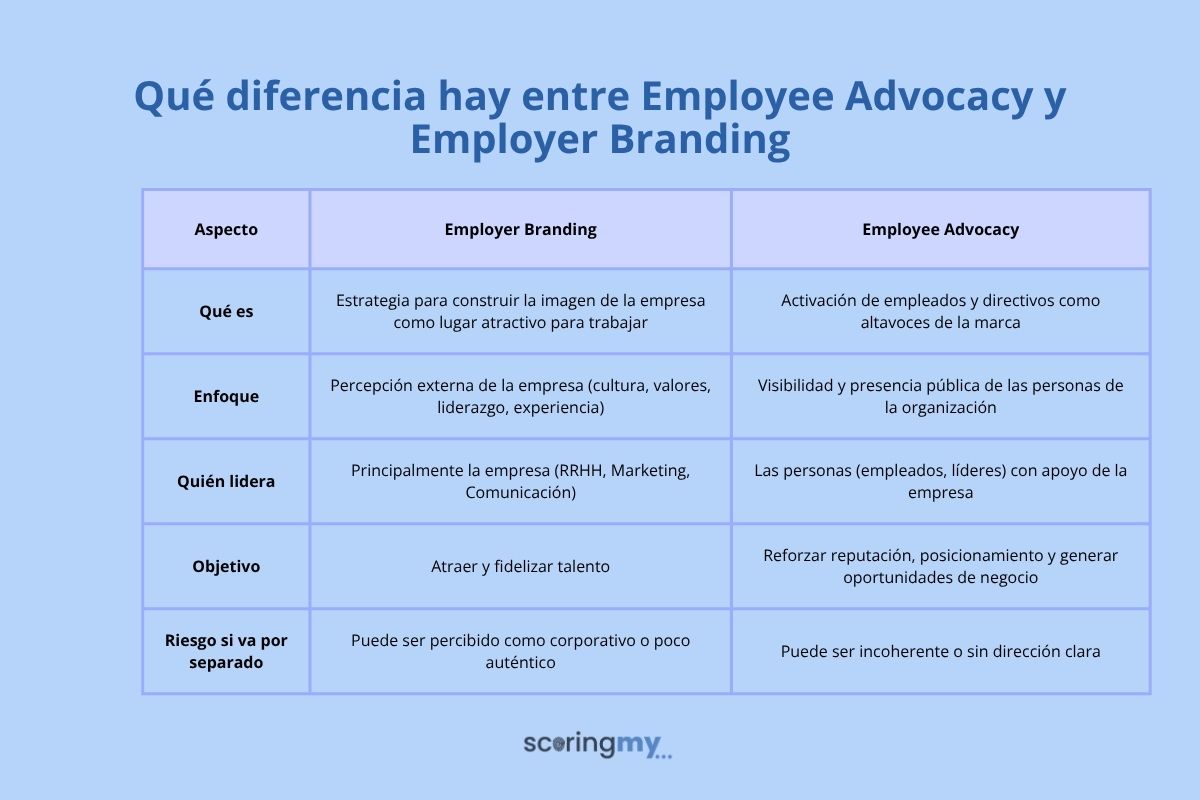
What’s the difference between employee advocacy and employer branding
It’s worth starting by clearly separating the two concepts.
Employer branding is the strategy through which a company builds and projects its appeal as a place to work.
It affects how people perceive the culture, the leadership, professional development, purpose, and the kind of experience a person expects to find if they join that organization.
Employee advocacy, by contrast, is the activation of employees’ and executives’ visibility so that their public presence helps reinforce reputation, positioning, communication, and business.
They aren’t the same.But they need each other.
Employer branding without employee advocacy can sound nice, but too institutional.
Employee advocacy without employer branding can generate activity, but with no clear direction.
When the two work together, the company achieves something far more powerful: an employer narrative that doesn’t depend on corporate messages alone, but on human signals spread across the whole organization.
Why LinkedIn is the natural meeting point between the two
LinkedIn isn’t just a network for posting job openings.
It’s a space where candidates, clients, partners, and professionals observe how a company behaves through the people who represent it.
Here the employer brand isn’t built with campaigns alone.
It’s also built with profiles.
With content.
With comments.
With conversations.
With the way executives, middle managers, experts, and teams show their work, their vision, and their culture.
That’s why LinkedIn is so important in this conversation.
Because it turns professionals into living storefronts of the company experience.
And that carries more force than many formal messages.
Your own data and reference materials point in that direction: an employee can generate up to 5x more reach than a brand, and employees’ posts or recommendations influence purchasing and attraction decisions. On top of that, 80% of talent managers say this helps attract better talent.
The big idea: talent trusts people more than slogans
This is probably the most important idea in the whole article.
When a company speaks well of itself, the market expects it.
When its professionals do, the effect changes.
Not because everything an employee says is taken as absolute truth.
But because the signal seems closer, more concrete, and less built to sell.
That’s especially important in talent.
Someone evaluating a company wants to see real indicators.
They want to observe how its leaders think.
How its experts express themselves.
Which topics the team’s people share.
Whether there’s judgment.
Whether there’s learning.
Whether there’s pride of belonging.
Whether there’s growth.
Employee advocacy doesn’t replace the employer value proposition.
It makes it visible in a more credible way.
What employee advocacy contributes to employer branding
1. It humanizes the employer brand
An overly corporate employer brand can come across as flat.
Correct, but flat.
When employees communicate from their own experience, the culture stops looking like website copy and starts looking like something lived.
That makes the company more tangible.
2. It multiplies the points of contact
The corporate page has a limited capacity.
Professionals expand that surface of visibility.
Each active profile adds a new entry point to the company.
And in employer branding, that’s worth a lot.
Because not every candidate arrives through the same channel or notices the same profiles.
3. It reinforces the credibility of the narrative
Saying “you learn a lot here” has an impact.
Seeing dozens of professionals sharing lessons, projects, milestones, and reflections has a far greater one.
Employee advocacy turns the employer value proposition into distributed evidence.
4. It makes visible talent that normally doesn’t communicate
Many companies rely too heavily on the voice of communications or leadership.
But external talent also observes experts, managers, recruiters, technical profiles, and sales teams.
Giving those profiles visibility greatly enriches the perception of the company.
Why many companies separate these two levers and lose force
This failure is fairly common.
Employer branding stays in HR.
Employee advocacy stays in communications or marketing.
Each area works with its own objectives, its own messages, and its own metrics.
And in the end nobody builds a genuinely integrated strategy.
The result usually looks like this:
On one hand, the company tries to project an image attractive to talent. On the other, its professionals communicate in a scattered way, without a framework or without activation. Or they simply don’t communicate at all. There, an enormous opportunity is lost.
Scoringmy can do a lot to unite these two layers, because it lets you measure the whole organization, segment by department, detect active employees and potential ambassadors, and understand which groups are in the best position today to reinforce visibility, reputation, or attraction. Working on employer branding by intuition isn’t the same as doing it while knowing which areas have the most activity, the best scoring, or the greatest capacity for impact.
How to know if your employer branding needs employee advocacy
There are fairly clear signs.
The first is that the company has an active corporate page, but very little real conversation from its professionals.
The second is that the culture messages sound good, but find no visible echo in the activity of employees or executives.
The third is that the company wants to attract talent, but doesn’t know which internal profiles are in the best position today to represent that value proposition.
The fourth is that HR and communications share an objective, but don’t share measurement.
The fifth is that there are employees with a lot of influence potential and nobody is helping them develop it.
If one or several of these things are happening, the company doesn’t just need more employer branding.
It needs to activate it through people.
What kind of professionals help most to reinforce employer branding
There’s no single answer.
And that’s precisely the point.
Talent attraction improves when the company shows a real diversity of voices.
Not just CEOs. Not just recruiters. Not just official spokespeople. Managers too. Technical profiles. Specialists. Sales teams. People leads. Middle managers. Professionals who describe well what they do and how they experience it.
Here one of Scoringmy’s big advantages is precisely the detection of potential ambassadors and segmentation by department.
That lets you avoid depending on the obvious profiles.
It lets you discover which people or which areas have the greatest capacity to help the employer brand through their own presence on LinkedIn.
What signals a company should measure to unite employee advocacy and employer branding
If an organization wants to work both levers at once, it needs data.
Not just inspiration.
Not just campaigns.
Data.
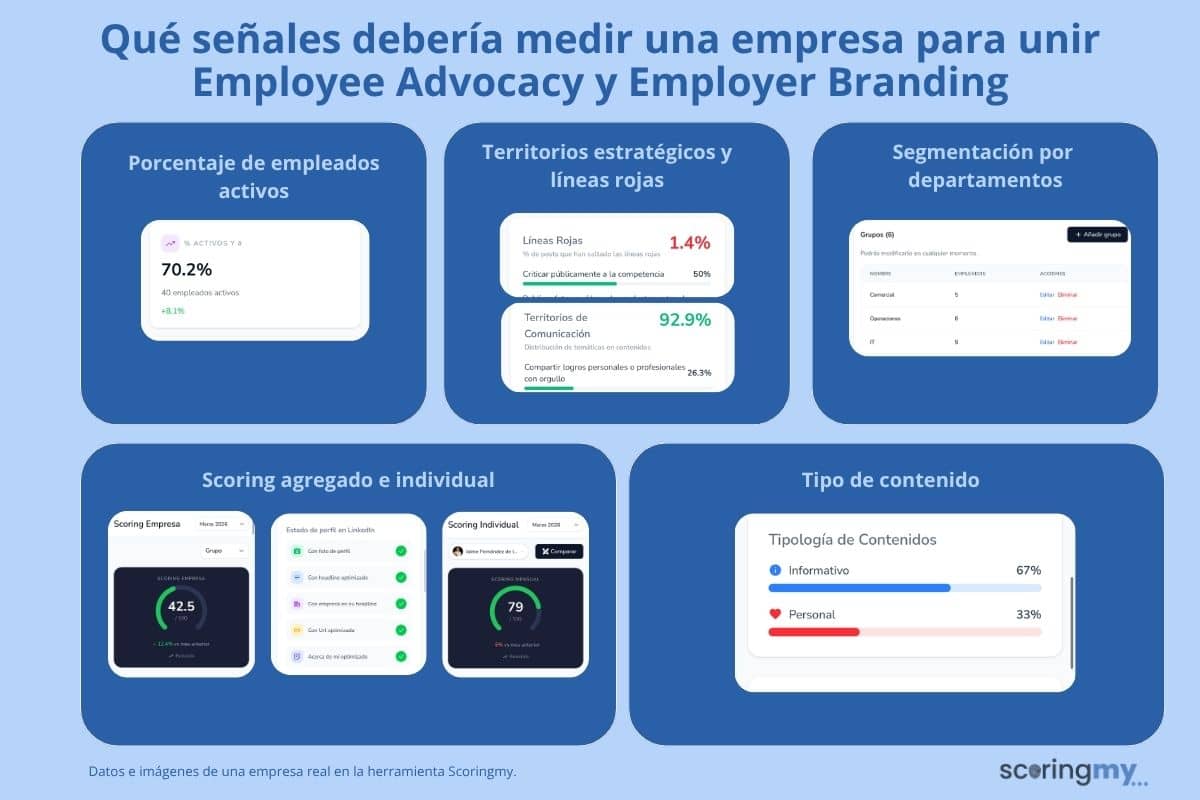
Percentage of active professionals
This figure lets you know what portion of the organization is generating public visibility.
In your analytical base, only 5.91% post at least once a month.
That shows most companies still have enormous room to turn their professionals into an engine of attraction and reputation.
Aggregate and individual scoring
It helps you understand the digital maturity of the organization and of each professional.
Knowing who posts isn’t enough.
What matters is knowing who is well positioned to generate a solid perception.
Segmentation by department
It’s key for knowing which areas are helping most to build visibility and which are underused.
It also lets you detect groups especially useful for employer branding, such as HR, managers, or experts.
Type of content
Not all content helps attract talent the same way.
It’s worth analyzing whether professionals are sharing experience, culture, lessons, vision, innovation, or simply corporate activity with no adaptation.
Strategic territories and red lines
This is another important differentiating layer.
Strong employer branding doesn’t need uncontrolled messages.
It needs human communication, yes, but ordered too.
Scoringmy lets you analyze what percentage of content falls within communication territories and what portion crosses red lines. That gives the company a lot of peace of mind and the professional a lot of useful freedom.
Why employees’ fear also affects employer branding
One of the reasons many companies fail to activate this layer is very human: fear.
Employees are afraid of getting it wrong.
Afraid of sounding too corporate.
Afraid of not knowing what to say.
Afraid their activity will be misinterpreted.
And when that fear isn’t managed, the consequence is direct: silence.
That silence hurts employee advocacy.
And employer branding too.
Because the company loses the chance to show a living culture through its people.
Here activation matters far more than simply inviting people to post.
That’s why it’s valuable that Scoringmy doesn’t stop at measuring. It also activates afterward with individual access to the data, an AI profile description, month-on-month comparison, content tools, challenges, and training. That combination helps turn fear into progress.
How AI helps activate employee advocacy without breaking authenticity
This point matters for employer branding too.
Many programs fail because they try to force a uniform discourse.
And it shows.
When all the professionals sound the same, credibility drops.
The company looks more controlling.
And talent perceives it.
That’s why one of Scoringmy’s most valuable features is the adaptation of corporate content to each professional’s personal style and the generation of content within strategic frameworks defined by the company.
That makes something very powerful possible: maintaining consistency without switching off the individual voice.
And that combination is gold for employer branding.
Because the culture doesn’t look dictated.
It looks lived.
And there it gains a lot of force.
What concrete benefits this union brings to talent attraction
More visibility of the real culture
Not the declared culture.
The visible culture.
The one seen in profiles, conversations, lessons, and the general tone of the teams.
More social proof
When several people from the company project consistency, specialization, and pride of belonging, talent receives far more solid signals.
More reach and more entry points
Each active professional expands the company’s public footprint.
That improves the likelihood of a relevant candidate crossing paths with the brand in a more human context.
More ability to stand out
Many companies say similar things about themselves.
What makes a real difference usually lies in how the people tell it.
How to build a joint strategy step by step
1. Measure the current situation
Before talking about activation, it’s worth knowing what’s happening today.
Which areas are most active.
Which profiles have the best scoring.
Which people are already communicating.
And what kind of content is being generated.
2. Detect priority profiles and groups
Not the whole company needs the same journey.
It’s worth detecting which profiles can reinforce the employer brand soonest and which departments make the most sense to activate.
3. Define communication territories
This is where you decide which topics should best reinforce the employer value proposition.
Not to straitjacket.
But to focus.
4. Activate with data, AI, and training
Here comes the practical part.
Individual access to the data.
Challenges.
Content ideas.
Adaptation of the corporate message to a personal style.
Profile improvement.
And support.
5. Measure evolution and recognition
Employer branding improves when the system is sustained.
That’s why monthly evolution, internal rankings, recognition, and visibility of progress matter so much.
Scoringmy incorporates precisely that layer of month-on-month comparison, internal ranking, and leaderboard, which helps sustain activation over time.
The costliest mistake: trying to attract talent without activating your people
Many companies invest in communicating culture.
But they don’t invest with the same seriousness in activating the people who can make it credible.
That gap is costly.
Because the employer brand becomes weaker than it could be.
Not for lack of narrative.
But for lack of voices.
And on LinkedIn, today, voices matter a lot.
That’s why employee advocacy shouldn’t be seen as an initiative separate from employer branding.
It should be seen as one of its most powerful ways of taking shape.
Frequently asked questions about employee advocacy and employer branding
Are employee advocacy and employer branding the same thing?
No. Employer branding builds the company’s appeal as a place to work. Employee advocacy activates employees’ and executives’ visibility to reinforce reputation, positioning, and communication.
Why is LinkedIn so important for uniting the two?
Because it’s the space where candidates and the market observe how a company behaves through its people.
Do all employees need to post?
No. What matters is detecting the profiles and groups with the most potential and activating them well.
What does Scoringmy contribute to this union?
Scoringmy lets you measure the visible activity of the whole company, segment by department, detect potential ambassadors, analyze territories and red lines, and then activate with AI, adapted content, challenges, and monthly follow-up.
Why does this help attract talent?
Because it makes visible a culture that’s more credible, more human, and better distributed than one a corporate page alone can project.
Make your employer branding stop sounding corporate and start looking real
If your company wants to attract talent better on LinkedIn, talking about culture from the corporate page isn’t enough.
That culture also needs to be seen in the people.
In how they present themselves.
In what they share.
In how they connect with the market.
And in how the company helps them do it without losing authenticity.
Book a Scoringmy demo and discover how to measure, detect, and activate the professionals who can reinforce your employer branding on LinkedIn with more credibility and more impact.

