
What an Employee Advocacy Platform on LinkedIn Should Measure Before You Buy It
Many companies look for an employee advocacy platform thinking about content first. They want their employees to share posts, to have ideas worth publishing, or to get the program up and running quickly. The problem is that if you start there, you’re starting late.
Before activating, before training, and before asking anyone to post more, an employee advocacy platform on LinkedIn should do something far more important: measure the whole company properly.
That’s the real starting point. Because you never know where the talent is. You never know for certain which professionals are already building visibility on their own, which profiles have a powerful voice in the market, or which employees are generating impact without the company seeing it.
And this happens more often than you’d think. At many companies there are already people speaking on LinkedIn without communications, marketing, or HR having a clear view of who they are, what they’re contributing, or what opportunity they represent for the business, its reputation, or talent attraction.
That’s why an advocacy platform that doesn’t first measure the organization’s complete presence starts out lame. Because it can’t detect where the active profiles are, which voices are already well cared for, which people have the best positioning, and who should be part of an ambassador program from the start.
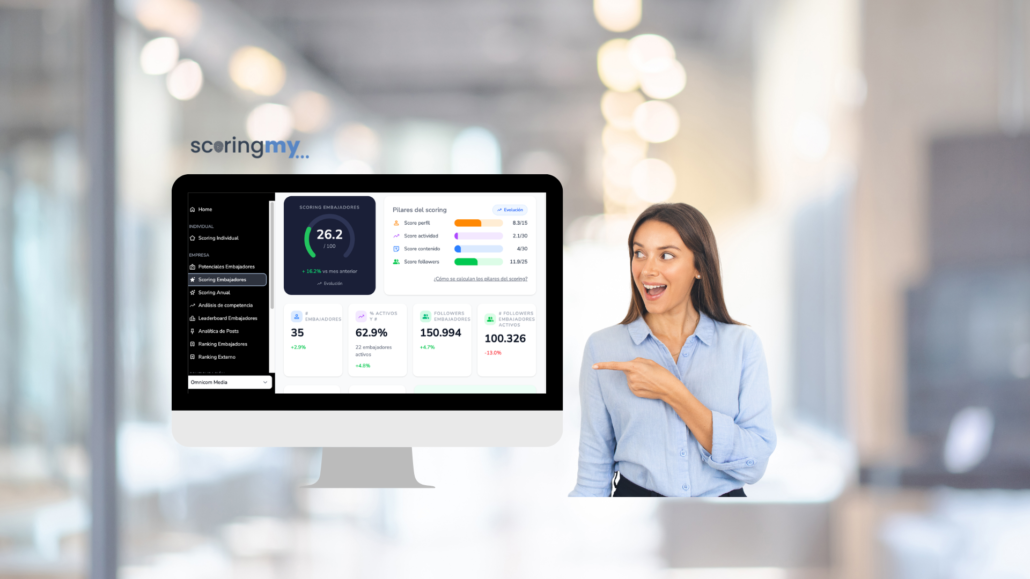
Scoringmy starts from exactly that logic. It doesn’t start with the post. It starts with the complete picture. It measures the whole company, detects active employees, organizes the information by scoring and key variables, segments by department, calculates economic impact, and turns that picture into a solid foundation for acting afterward with goals, red lines, strategic territories, AI, training, and monthly follow-up.
In this article we’ll look at what an employee advocacy platform on LinkedIn should really measure before you buy it, why those metrics matter so much, and how they should be used to move from analytics to activation with judgment.
Table of contents
- Why an advocacy platform has to start by measuring
- Why you have to measure the whole company, not just one group
- The first metrics a platform should show
- Scoring and LinkedIn’s 4 key pillars
- Which metrics it should measure at company level
- Which metrics it should measure by department
- Why earned media value is a mandatory metric
- How to use this data to set real goals
- Why red lines and strategic territories come next
- How to invite and activate ambassadors with data
- What sets Scoringmy apart from other platforms
- Frequently asked questions
Why an advocacy platform has to start by measuring
An employee advocacy platform shouldn’t be bought in order to “post more.” It should be bought to understand where the company stands on LinkedIn today and how it can improve through a structured logic.
That distinction is decisive. Because encouraging people to share content is one thing. Building an ambassador program with an impact on reputation, employer branding, sales, and visibility is something else entirely.
And to build that, the first thing isn’t content. The first thing is measurement.
Measuring means knowing which part of the organization is already active, which part isn’t, which professionals have the most potential, which departments are most visible, what economic impact is being generated, and what opportunities are going unused today.
Without that layer, any program runs on intuition. With it, the company can start making decisions on solid ground.
Why you have to measure the whole company, not just one group
Here’s one of the market’s most common mistakes. Many companies think about advocacy and immediately narrow the focus to executives, a small group of ambassadors, or the communications team.
That may make sense later. But not at the beginning.
The first thing a serious platform should do is measure the whole company. Because you never know where the talent is. You never know where the person with the most powerful voice is, the one with the best profile, the greatest ability to connect, or a presence far more mature than it seemed from the inside.
What’s more, there are often people already speaking without the company having really identified them. And that’s one of the clearest opportunities in any advocacy program: identifying those active profiles, seeing what they’re doing well, and making them the foundation of the program.
That’s why Scoringmy measures the entire company. It doesn’t settle for a small sample. It lets you see total employees, active employees, aggregate scoring, total followers, economic impact, content type, red lines, communication territories, and goals at both company and ambassador level.
That approach changes the starting point. Instead of choosing ambassadors on intuition, you can detect them with data.
The first metrics a platform should show
Before getting into more sophisticated layers, an employee advocacy platform should handle a few basic metrics well. They’re the ones that tell you whether you’re really seeing the company’s overall picture.
Percentage of active employees
This metric is fundamental. It tells you what portion of the organization posts at least once in the period analyzed. Without this figure, you don’t know whether you have a real base for activation or whether everything depends on a handful of visible profiles.
It’s also one of the best ways to size the opportunity. If a company discovers only a small percentage is active, it quickly understands how much room it has to grow.
Posting frequency among active employees
Knowing who posts isn’t enough. You also need to know how consistently they do it. That’s where the average number of posts by active employees comes in.
This metric helps you see whether the company has a communication habit or just sporadic activity.
Average engagement rate
Another key metric. Because it isn’t only about being visible; it’s about generating a response. The average ER helps you understand the relative quality of the connection the company is achieving through its professionals.
Earned media value or economic impact
This is one of the big differentiators a serious platform should calculate. Seeing activity isn’t enough. That activity also has to be translated into value.
Scoringmy does this by estimating the impact generated by its professionals and comparing it with what that same visibility would cost through LinkedIn Ads campaigns. That turns employee visibility into an economic figure the company can understand.
Scoring and LinkedIn’s 4 key pillars
Those first metrics already give you part of the picture. But a good platform shouldn’t stop there. It needs a logic that summarizes the maturity of the company’s presence and of each professional.
That’s where scoring comes in.
In Scoringmy’s case, the scoring rests on four pillars: profile, followers, activity, and content. This structure is powerful because it doesn’t measure a single signal. It measures the overall quality of professional presence on LinkedIn.
Profile
Here we check whether the person has a solid foundation. Photo, headline, optimized URL, summary, experience, and other elements that shape first impressions and professional positioning.
Followers
This pillar measures the size and potential of the community. It isn’t only about how much you post. It’s also about how many relevant people you can reach.
Activity
This covers frequency and consistency. A strong commercial or reputational presence on LinkedIn isn’t built on a couple of isolated posts.
Content
This pillar looks at content quality, its type, the balance between original posts and reposts, company mentions, and alignment with the strategy.
Thanks to these four pillars, the company doesn’t just know whether there’s activity. It knows the quality of that presence and where the levers for improvement are.
Which metrics it should measure at company level
If a platform wants to be genuinely useful, it has to offer a complete view at company level. Not a pile of isolated profiles.
On this front, Scoringmy offers a very high level of data. And that matters, because the company needs to see the aggregate picture before designing a program.
Company-wide scoring
It’s the general reference point for the average level of LinkedIn maturity. It’s also the basis for setting goals.
Total number of employees measured
This helps you understand the real scope of the analysis and the size of the organization studied.
Percentage and number of active employees
This shows what portion of the workforce is contributing to the company’s visibility today.
Total followers of the company and of active employees
A highly relevant metric, because it shows the accumulated potential reach the organization has through its people.
Monthly economic impact and annual projection
This layer is critical. It lets you translate current activity into equivalent value and project the annual potential of that visibility.
General profile data
Percentage with a profile photo, an optimized URL, a well-crafted headline, the company in the headline, or an optimized “About” section. All of this helps you understand the average quality of the base the program is built on.
Volume of original posts and average posts
This is where you get into the real quality of the posting habit.
Average engagement rate
Very useful for knowing how well the professionals’ activity is connecting with their audiences.
Estimated impressions
A good platform should also translate activity into visible exposure.
Content format
A company that works image, video, article, and text in balance isn’t the same as one that repeats a single format.
Content type
This shows how much content is personal, informational, corporate, or educational. This layer helps a great deal in understanding whether the company is building a credible voice or an overly corporate one.
ER by content type
Very powerful for understanding which kind of content connects best within that organization.
Original posts vs. reposts
Key to detecting whether professionals are building a voice or simply amplifying.
Percentage that mentions the company
Very useful for reading the balance between personal brand and corporate brand.
Red lines and communication territories
Here we get into one of Scoringmy’s most differentiating layers. It doesn’t just measure activity. It also measures whether that activity is aligned with the company’s framework.
Which metrics it should measure by department
Another thing a strong platform should offer is segmentation by group or department. Because not every area contributes value in the same way, and not every area has the same potential.
Marketing doesn’t communicate the way sales does. HR doesn’t communicate the way leadership does. A technical area doesn’t play the same role as a sales team.
That’s why measuring by department completely changes the usefulness of the analysis.
At this level it’s worth reviewing the same broad metric families, but grounded in each group:
- department average scoring
- percentage of active employees
- average followers
- posting frequency
- average ER
- content type
- percentage of original posts
- percentage that mentions the company
- alignment with territories
- percentage of red lines
- economic impact
This segmented view makes it much easier to spot where the opportunity lies today. It also helps you decide where to activate first and how to tailor the program to each type of profile.
Why earned media value is a mandatory metric
If an employee advocacy platform can’t translate activity into economic value, it falls short of convincing leadership.
That’s why earned media value, or economic impact, is such an important metric. Because it turns your professionals’ presence into a language the company understands.
Scoringmy frames this very clearly. It estimates the impressions generated by professionals and compares them with what it would cost to achieve that same visibility through LinkedIn Ads. Put another way: if your company had to buy that exposure, how much would it need to invest?
That logic helps enormously. The activity stops looking merely social. It becomes visible value, communication efficiency, and a measurable asset.
And when the platform projects that impact monthly and annually, the company can clearly see the opportunity cost of not activating its professionals properly.
How to use this data to set real goals
A good platform shouldn’t stop at displaying dashboards. It should help you turn measurement into goals.
And here another very interesting Scoringmy layer comes in: the ability to set goals for both the company and its ambassadors.
That’s key, because a serious program needs targets. Not just a snapshot of the present.
With the current data, the company can decide how much it wants to raise its overall scoring, how many more active employees it wants to bring in, how much it wants to increase average followers per active employee, what the average number of posts should be, what ER it’s aiming for, what percentage of original posts it wants, how much it needs to improve on territories, and how far it needs to bring red lines down.
And the most powerful part is that this improvement translates into economic impact.
In the goals view you shared, this logic shows up clearly. The platform doesn’t just display the current situation and the target. It also projects the calculated annual economic impact, the estimated monthly impact, and even the expected ROI.
That turns the advocacy plan into a far more defensible roadmap.
Why red lines and strategic territories come next
Once you have the company’s picture and clear goals, the next logical step arrives: defining the framework.
And here red lines and strategic territories become key again.
Knowing who could be part of the program isn’t enough. You also have to give those profiles confidence. They need to understand what’s worth talking about, which topics reinforce the company’s position, and which messages are best avoided.
This step is fundamental because it activates people with less fear. The professional stops improvising. They no longer feel they have to guess whether something fits. They communicate within a much clearer framework.
And because Scoringmy then measures the percentage of content aligned with territories and the percentage that falls into red lines, the company can see whether that framework is working or not.
How to invite and activate ambassadors with data
Once the platform has measured, detected talent, segmented by area, and set goals, the activation phase arrives.
And here too there’s a clear difference between a superficial tool and a well-designed platform.
The ambassador needs to know where they stand today. What their scoring is. What their activity contributes to the company. What economic impact they generate. What they’re doing well. And which goals they can help reach if they improve their presence.
When a person sees their own data, the conversation changes. It’s no longer “post because it’s good for the company.” It’s “here’s where you stand, here’s what you’re contributing, and here’s the opportunity to improve.”
At Scoringmy this is also supported by individual access to the data, month-on-month comparisons, ambassador goals, training, AI, content generation, and challenges. That combination means activation doesn’t depend on goodwill alone. It becomes a process of continuous improvement.
And there’s another important detail we shouldn’t lose here: goals shouldn’t be set only for the active ambassadors. They should also be set for the company as a whole.
Because the program shouldn’t limit itself to maintaining those who already stand out. It should also grow the participation base and improve the organization’s overall maturity.
What sets Scoringmy apart from other platforms
If we boil all of this down to a buying question, the difference is fairly clear. Many tools help you post. Some help you distribute content. Others allow for a degree of analytics.
Scoringmy goes further because it starts from a much more complete view of the program.
First it measures the whole company. Then it detects where the talent is. Then it organizes the information with scoring, activity, ER, followers, economic impact, content, red lines, and territories. From there it lets you set goals for both the company and its ambassadors. And finally it helps you activate with individual data, AI, content, challenges, and follow-up.
That means it isn’t just a publishing tool. It’s an analytics and activation platform for turning LinkedIn presence into a real lever for visibility, reputation, employer branding, and business.
The key idea: measure first, activate second
If a company is evaluating employee advocacy platforms on LinkedIn, this should be the central idea: measure first, activate second.
Not the other way around.
Because without a complete picture of the organization, without knowing where the talent is, without knowing the average scoring, without measuring active employees, ER, followers, frequency, economic impact, and content quality, any program is flying blind.
By contrast, when a platform lets you see all of that and turn it into goals, a framework, and activation, the program stops being an intuitive bet and becomes a strategy.
And that’s the real value of a good advocacy platform.
Frequently asked questions about what an employee advocacy platform should measure
What’s the first thing an advocacy platform should measure?
The first thing is the complete LinkedIn presence of the whole company: employees, active employees, average scoring, followers, activity, and economic impact.
Why isn’t it enough to measure only the ambassadors?
Because you never know where the talent is. There are often already active profiles, or people with a powerful voice, that the company hasn’t yet identified.
Which metrics are essential?
Percentage of active employees, posting frequency, average ER, earned media value, average scoring, followers, content type, original posts, company mentions, red lines, and territories.
Why is scoring so important?
Because it summarizes the maturity of LinkedIn presence across profile, followers, activity, and content, and it lets you set improvement goals with more judgment.
What does Scoringmy contribute that’s different?
Measurement of the whole company, segmentation by department, individual and aggregate scoring, economic impact, red lines, communication territories, goals for the company and its ambassadors, and subsequent activation with data, AI, training, and challenges.
Start with the platform that helps you see the whole picture
If you’re evaluating an employee advocacy platform on LinkedIn, don’t look only at whether it helps people share content. Look first at whether it helps you truly understand where your company stands, where the talent is, what economic impact already exists, and what goals you could reach if you activated your professionals better.
That’s where a platform stops being a publishing tool and becomes a strategic lever.
Book a Scoringmy demo and discover how to measure your entire company, detect ambassadors, set goals, and activate an employee advocacy program on a much more solid data foundation.


