Red Lines and Communication Territories: The Foundation of an Employee Advocacy Program That Works
Many employee advocacy programs don’t fail for lack of enthusiasm. They fail for lack of a framework.
The company wants its professionals to be more visible. It wants them talking on LinkedIn. It wants them to build reputation, strengthen employer branding, or help generate business. But when the moment comes to actually activate, the block appears.
Employees hesitate. They don’t know what to talk about. They’re unclear on how far they can go. They’re afraid of getting it wrong. And often, they’d rather not post at all than post something that could cause them trouble.
That fear isn’t resolved with empty phrases like “post freely” or “just be yourself.” It’s resolved with a clear structure. With a framework that helps people communicate confidently without switching off their authenticity.
That’s where two concepts come in that are fundamental to any serious program: red lines and communication territories.
Red lines mark what’s best avoided. Communication territories mark what’s worth amplifying. One protects. The other guides. Together, they make visibility far more sustainable.
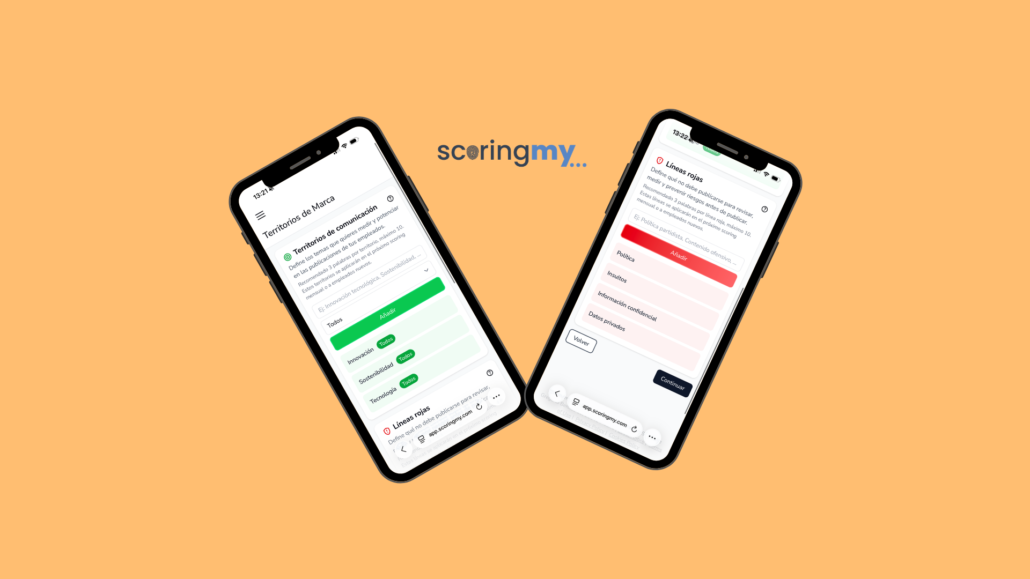
At Scoringmy this layer carries real weight, because the platform doesn’t stop at measuring activity or scoring. It also lets you analyze what percentage of published content falls within your strategic territories and what portion crosses the red lines your company has defined. And for communications, marketing, or leadership, that changes the level of intelligent control you can have over the program.
In this article we’ll look at what red lines are, what communication territories are, why they matter so much on LinkedIn, how they help activate employees with less fear, and how Scoringmy lets you measure and act on this layer in a way very few tools handle well.
Table of contents
- Why many employees don’t post more on LinkedIn
- What red lines are in an employee advocacy program
- What communication territories are
- Why both pieces have to work together
- Real examples of red lines on LinkedIn
- Real examples of communication territories
- How to define them within a company
- How Scoringmy helps measure and act on this framework
- How they help activate employees with less fear and more focus
- Common mistakes worth avoiding
- Frequently asked questions
Why many employees don’t post more on LinkedIn
When a company tries to activate its professionals on LinkedIn, it usually hits the same wall. It isn’t a lack of talent. It isn’t a lack of knowledge. It isn’t a lack of value to share.
What shows up, almost always, is a mix of fear, doubt, and a lack of clarity. The professional doesn’t know whether they can talk about certain topics. They’re unclear on how to blend their personal voice with the company’s strategy. They don’t know whether to mention the company too much or too little.
In some cases, the block is more practical. They don’t know what to talk about. They don’t have time. They don’t want to sound corporate. They don’t want to copy messages dictated by others. But underneath all of that there’s usually a common root: no framework clear enough to let them communicate with peace of mind.
That’s why this topic matters so much. Before asking for more posts, many companies should do better work on their rules of the game. Not to make communication rigid, but to make it easier to activate.
What red lines are in an employee advocacy program
Red lines are the limits that help an organization protect its public communication and reduce unnecessary risk.
This isn’t about censorship. It isn’t about turning LinkedIn into surveilled territory. It’s about clearly defining which types of messages, angles, or topics could create a reputational, legal, strategic, or cultural problem for the company.
When there are no red lines, the professional hesitates. And when they hesitate too much, they usually go quiet. But when they know what’s best avoided and why, freedom of action becomes far more comfortable.
A well-defined red line doesn’t silence the employee’s voice. It protects it. And at the same time, it protects the organization.
That point is key, because many companies make a common mistake. They think setting limits will discourage participation. What usually happens is the opposite: if the framework is well designed, people feel safer communicating.

What communication territories are
If red lines mark what’s best avoided, communication territories mark what’s worth amplifying.
A communication territory is a thematic axis on which the company wants to build visibility, authority, and brand association through its professionals.
They aren’t empty labels. They’re conversation areas that make sense for the business, for positioning, and for the company’s reputation on LinkedIn.
For example, a company might decide it wants to be associated with innovation, sustainability, cultural impact, artificial intelligence, leadership, or industry transformation. If those are its territories, it makes sense to help employees and executives post more content related to them.
Here’s one of the great advantages of working with territories. Instead of telling a professional “post something,” you tell them “here are five or six areas where your voice can add real value and help the company’s positioning.”
That significantly reduces the fear of the blank page.And it turns activity into something more strategic.
Why both pieces have to work together
Many companies fall into one of two extremes. Either they create a very rigid control framework, full of prohibitions and devoid of inspiration. Or they grant total freedom, but with no focus or structure.
Neither option tends to work well.
If you only work on red lines, you create a sense of risk and surveillance that can shut down participation. If you only work on territories and set no limits, the company exposes itself to disorganized, inconsistent, or even problematic messages.
The right combination is different: protect without suffocating, and guide without homogenizing. Red lines provide safety. Communication territories provide direction. Together, these two layers create the ideal ground for professionals to post with more judgment, more confidence, and more consistency.
And that’s one of the great strengths of the Scoringmy approach. The tool doesn’t just help detect activity. It also measures the percentage of content aligned with communication territories and the percentage of posts that cross red lines. That makes it possible to move from theory to actually managing the program.

Real examples of red lines on LinkedIn
It’s worth being practical here. Red lines aren’t the same at every company, but they tend to cluster into certain groups.
Political or ideological topics in sensitive contexts
Some organizations prefer that certain profiles not enter political conversations from their public professional presence. Not because the topic doesn’t exist, but because it can generate noise or associate the company with debates it has no interest in occupying.
Internal complaints or workplace conflicts aired without a filter
Sharing a professional experience is one thing. Turning LinkedIn into a venting channel about internal problems, leadership, or company decisions is another.
Offensive or crude language
It seems obvious, but it’s worth writing down. Form communicates too. And a company’s public reputation can be affected by the tone its professionals use.
Sensitive or confidential information
This point is critical. Some people post with good intentions but without properly gauging which parts of the information should stay private.
Aggressive sales messages, or messages poorly aligned with the brand
For sales teams this matters. Not everything goes when it comes to selling. A professional can damage their own credibility and the company’s if they use LinkedIn in a way that’s too invasive or careless.
In one of your Scoringmy screenshots you can see exactly how this layer becomes data. The platform shows the total percentage of content that crossed red lines and also lets you view the distribution across specific categories. That turns an ambiguous topic into a measurable signal.
Real examples of communication territories
Territories, for their part, should connect with the positioning the company wants to build in the market.
There don’t need to be many. In fact, it usually works better to have a few that are well defined.
Innovation and industry transformation
Very useful for companies that want to be seen as a reference point for change, progress, or modernization.
Cultural impact and purpose
Works well when the company wants to reinforce a more human narrative, tied to culture, values, or internal transformation.
Artificial intelligence and digitalization
Especially powerful in technology, consulting, marketing, or companies where applied innovation is part of the story.
Customer experience or expert knowledge
Very important for sales, consulting, or executive profiles who want to build authority from what they learn in the market.
Sustainability
Makes sense when the business, the sector, or the positioning strategy wants to occupy that space clearly and credibly.
This shows up well in your screenshots too. Scoringmy doesn’t just identify the total percentage of content that fits within the territories; it breaks down how much weight each theme carries within the conversation. That layer is valuable because it lets you know whether the company’s real positioning matches the one it claims to be pursuing.
How to define red lines and territories within a company
The most important thing here is avoiding two mistakes. First, improvising. Second, doing it in an excessively theoretical way.
A good framework should be built with practical sense. It has to be easy for employees to understand. Easy to remember. And easy to apply when they’re writing or thinking about what to post.
Start with the company strategy
Before defining anything, the organization should be clear on what it wants to project on LinkedIn. Which topics it wants to occupy. What kind of reputation it wants to reinforce. What role it wants its employees and executives to play.
Translate the strategy into concrete topics
Territories shouldn’t be written in abstract corporate language. They should become topics a professional can recognize and develop easily.
Clearly separate what’s encouraged from what’s avoided
This point is fundamental. What helps isn’t mixing everything into one long guide. What helps is the professional quickly understanding where they can move freely and which zones are best avoided.
Adapt the framework to different groups
An executive, a salesperson, a recruiter, and a technical expert don’t communicate the same way. Sometimes it makes sense to adjust certain examples or priorities by department or role.
Here Scoringmy’s segmentation comes back in as a very useful capability, because it lets you avoid treating the whole company as homogeneous and read activity by department or specific group.
How Scoringmy helps measure and act on this framework
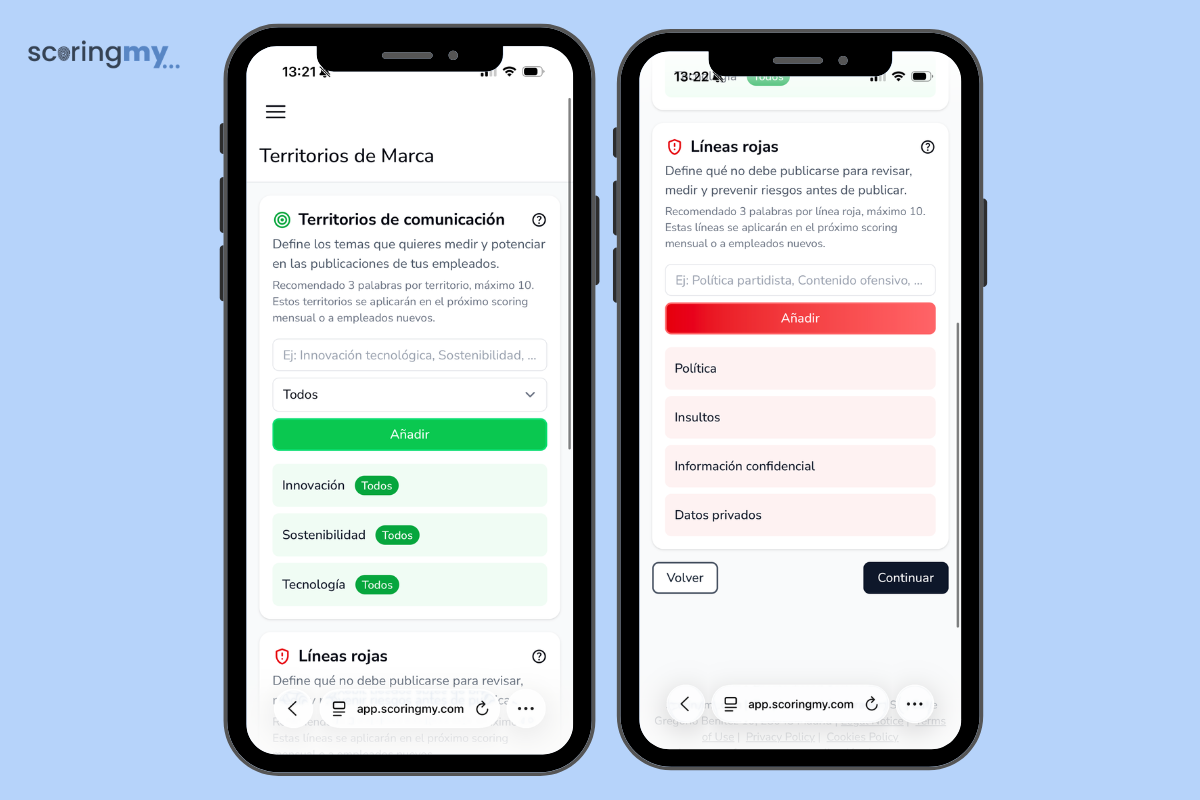
This is one of the most differentiating parts of the product. Scoringmy doesn’t stop at saying “it would be good to define red lines and territories.” It turns them into something visible, measurable, and actionable.
Measuring the percentage of red lines
The platform lets you see what portion of published content falls outside the framework the company has defined. That’s a very clear signal of risk or misalignment.
Measuring the weight of communication territories
It also lets you analyze what percentage of the conversation is genuinely reinforcing the strategic territories the organization has defined. That helps you know whether the company is building the positioning it wants, or just scattered activity.
Individual and aggregate detail
Knowing that the company as a whole has a certain level of alignment isn’t the same as understanding which profiles or groups are most out of step. Scoringmy lets you go down to that level of detail.
Month-on-month comparison
This matters a lot. A framework isn’t only useful on day one. It’s useful for seeing whether the organization improves over time. Monthly evolution helps you check whether the program is genuinely bringing order to communication.
Activation afterward
Here’s something key: measuring isn’t enough. Afterward you have to help people improve. And there Scoringmy provides very useful tools like individual access to the data, AI content generation, adapting corporate content to a personal style, training, and challenges.
That way, red lines and territories aren’t perceived as a cold rule, but as part of a system that supports better communication.
How they help activate employees with less fear and more focus
One of the biggest benefits of this framework is that it reduces friction. The employee no longer feels they have to improvise from scratch. They know which topics they have freedom to build a voice around. They know what kinds of risks are best avoided. And they know they can communicate within a much clearer perimeter.
That reduces the fear of getting it wrong.
It also helps unblock the lack of ideas. When the company has defined territories, it becomes far easier to generate personal content or adapt corporate content with a strategic purpose.
And it avoids another very common problem: everyone ending up sounding the same. The professional can keep their own style, but within a more orderly framework. That blend of authenticity and clarity is what makes an employee advocacy program genuinely scale.
In your approach, this activation goes well beyond simple control. Scoringmy helps detect, measure, give feedback, generate ideas, adapt messages, and sustain improvement through challenges and monthly evolution. That’s one of the major differentiators against tools that stop at analytics alone or content alone.
Common mistakes worth avoiding
The first is defining red lines that are too vague. If the employee doesn’t clearly understand what they mean, they don’t help. They just create more doubt.
The second is creating territories that are too abstract. If a territory can’t be turned into concrete content examples, it isn’t really useful.
The third is using this framework as an excessive control system. If everything feels like supervision, participation drops.
The fourth is not measuring afterward. Defining red lines and territories is fine, but if they aren’t analyzed with data, the company doesn’t know whether the framework is working.The fifth is not supporting activation. If the organization defines the framework but doesn’t provide ideas, content, AI, challenges, or training, the change will fall short.
Communicating better isn’t communicating without limits — it’s communicating with judgment
That’s the heart of this whole article. Companies that want to activate their professionals on LinkedIn need more than enthusiasm. They need a framework that reduces fear, provides focus, and turns visibility into a more consistent lever.
Red lines help protect. Communication territories help guide. Together, they make employee advocacy stop being a pile of posts and start looking like a real positioning strategy.
And that’s where Scoringmy adds very different value. Because it lets you measure this layer, turn it into data, and use it to activate the organization more effectively. Not just through control, but through practical improvement of the profile, the content, the focus, and the evolution.
Frequently asked questions about red lines and communication territories
What are red lines on LinkedIn?
They’re the limits that help avoid content or angles that could create a reputational, legal, or strategic problem for the company.
What are communication territories?
They’re the thematic areas the company wants to amplify in order to build visibility, authority, and positioning on LinkedIn through its professionals.
Why is it important to work on both at once?
Because red lines provide safety and territories provide focus. Together, they help people communicate with more confidence and consistency.
What does Scoringmy contribute here?
It lets you measure the percentage of content aligned with territories, detect posts outside the red lines, analyze individual and aggregate detail, and then activate with AI, training, ideas, and monthly follow-up.
Does this help employees post more?
Yes, because it reduces fear, provides clarity, and makes it far easier to know what to talk about and how.
Activate your employees with more confidence and more strategy
If your company wants its professionals to be more visible on LinkedIn, the first step isn’t asking for more posts. The first step is creating a framework that helps them communicate with less fear and more judgment.
That’s where red lines and communication territories make an enormous difference. And that’s also where Scoringmy can help you measure, organize, and act on that strategy with much more solid logic.
Book a Scoringmy demo and discover how to define, measure, and improve your professionals’ communication on LinkedIn from a framework that’s clear, useful, and connected to your company’s strategy.


