Employer Branding on LinkedIn

Employer branding is no longer won from the corporate page alone. It’s won through the people who work at your company and who make what happens inside visible.
For years, many companies thought building an employer brand meant designing a nice message, publishing it on the careers page, reinforcing it on LinkedIn, and waiting for results. Today that falls short.
The market is no longer satisfied with the official narrative. It wants signals. It wants to see executives showing up, managers who are visible, and professionals who explain naturally how they work, what projects they lead, and what culture they actually live.
That shift is exactly what explains why modern employer branding depends more on your employees than on your corporate page.
And that’s where a major opportunity appears. If your company manages to measure, activate, and improve its professionals’ presence on LinkedIn, it won’t just attract more talent. It will also strengthen its reputation, gain commercial credibility, and make its value proposition far more visible in the market.
That’s the field Scoringmy.com plays on: not as a simple employee advocacy tool, but as an analytics and activation platform for the LinkedIn presence of every professional at a company.
- What employer branding is today
- Why it no longer depends on the corporate page alone
- Why LinkedIn is the key channel
- What signals a candidate looks at before trusting you
- The real problem for most companies
- How Scoringmy helps measure and activate employer branding
- What the sector data says in Spain
- The role of executives and managers
- Common employer branding mistakes on LinkedIn
- What a company should do starting now
What employer branding is today
Employer branding is how the market perceives your company as a place to work. It covers culture, leadership, development opportunities, internal reputation, and consistency between what you promise and what people actually experience.
The definition sounds simple, but in practice it carries a strong implication: your employer brand isn’t what your company says about itself. It’s what the market believes when it compares your message with the public evidence it finds.
That’s why employer branding is no longer an isolated HR function. Today it touches communications, marketing, sales, and the C-suite directly.
At B2B companies this is even clearer. When a candidate researches a company, they don’t just assess whether it looks like an attractive place to work. They also read whether it’s serious, whether it has visible leadership, whether it projects expertise, and whether its professionals look like authorities in their field.
In other words: a strong employer brand also improves brand perception, reputation, and commercial trust.
Why it no longer depends on the corporate page alone
The corporate page is still useful. It organizes information, provides context, and serves as the official storefront. The problem is believing that’s enough to build trust.
The reality is different. People trust people more than they trust brand messages. On LinkedIn that’s even more pronounced, because users don’t come only to read what a company posts. They come to see who represents it and how those people behave.
If a candidate finds an impeccable corporate page but then discovers that its executives don’t post, its employees are absent, and nobody explains anything in their own voice, perception drops.
The brand sounds manufactured. The culture seems theoretical. The company becomes less credible.
By contrast, when they see active profiles, expert content, personal posts with a point of view, and consistent signals across different areas, the reading changes completely. The company looks more human, more mature, and more trustworthy.
That’s the current turn in employer branding: it’s no longer led by corporate communications alone. It’s led by the visible sum of the professional communication of employees, managers, and executives.
Why LinkedIn is the key channel
LinkedIn is where reputation, talent, personal brand, B2B sales, and sector authority all intersect. It’s not just a social network. It’s a professional storefront in real time.
That’s why employer branding on LinkedIn has a multiplier effect. A company can strengthen its appeal as an employer and, at the same time, improve the visibility of its expertise, the perception of its leadership, and the commercial strength of its teams.
What’s more, the distribution logic favors people. Employees’ networks are on average far larger than the follower base of company pages. And content shared by people is perceived as more authentic and draws more attention.
From an employer branding standpoint, that shifts the center of gravity. The corporate page is no longer the main engine of reach. It’s a supporting piece. The real engine is the aggregate network of the company’s professionals.
At Scoringmy this point is central. The platform starts from a simple but powerful idea: a company’s communication is everyone’s business, not just the brand’s and not just the executives’.
What signals a candidate looks at before trusting you
A candidate doesn’t decide based on a promise. They decide based on an accumulation of signals.
They look at whether the company is alive or whether it seems like a static brand. They watch whether its key profiles post or disappear. They check whether the content is purely corporate, or whether there’s also personal judgment, learning, and professional context.
They also pay attention to something very important: consistency. If a company says it invests in its people, but its employees have no visibility, no voice, and no digital presence, that message loses force.
The same goes for innovation, leadership, a collaborative culture, or internal development. If it isn’t visible in the profiles, it’s hard to believe.
That’s one of the great advantages of employer branding built through employees. It doesn’t just tell. It shows. It demonstrates. It repeats real signals.
And the more those signals repeat across different profiles, the more solid the perception of the company becomes.
The real problem for most companies
Most companies don’t have a narrative problem. They have a distributed visibility problem.
There are companies with a good value proposition, brilliant professionals, and clear positioning. But it isn’t visible from the outside. Or it’s only visible on the corporate account. Or it depends on one or two people. Or it can’t be measured.
That’s the real bottleneck. Without analytics, everything runs on intuition. Campaigns get launched, internal initiatives get rolled out, people get encouraged to post, corporate content gets shared, but nobody knows precisely what’s happening.
Nobody knows which departments have the most presence. Nobody knows what kind of content is reinforcing the employer brand. Nobody knows which profiles have ambassador potential. Nobody knows which executives are carrying the reputation and which have gone missing.
And above all, nobody knows what economic, reputational, or competitive impact the company’s aggregate activity is generating.
That’s exactly what Scoringmy solves.

How Scoringmy helps measure and activate employer branding
Scoringmy.com is built for companies that want to move from intuition to analytics. It doesn’t stop at making posting easier or distributing corporate content. Its focus is on measuring first and activating afterward.
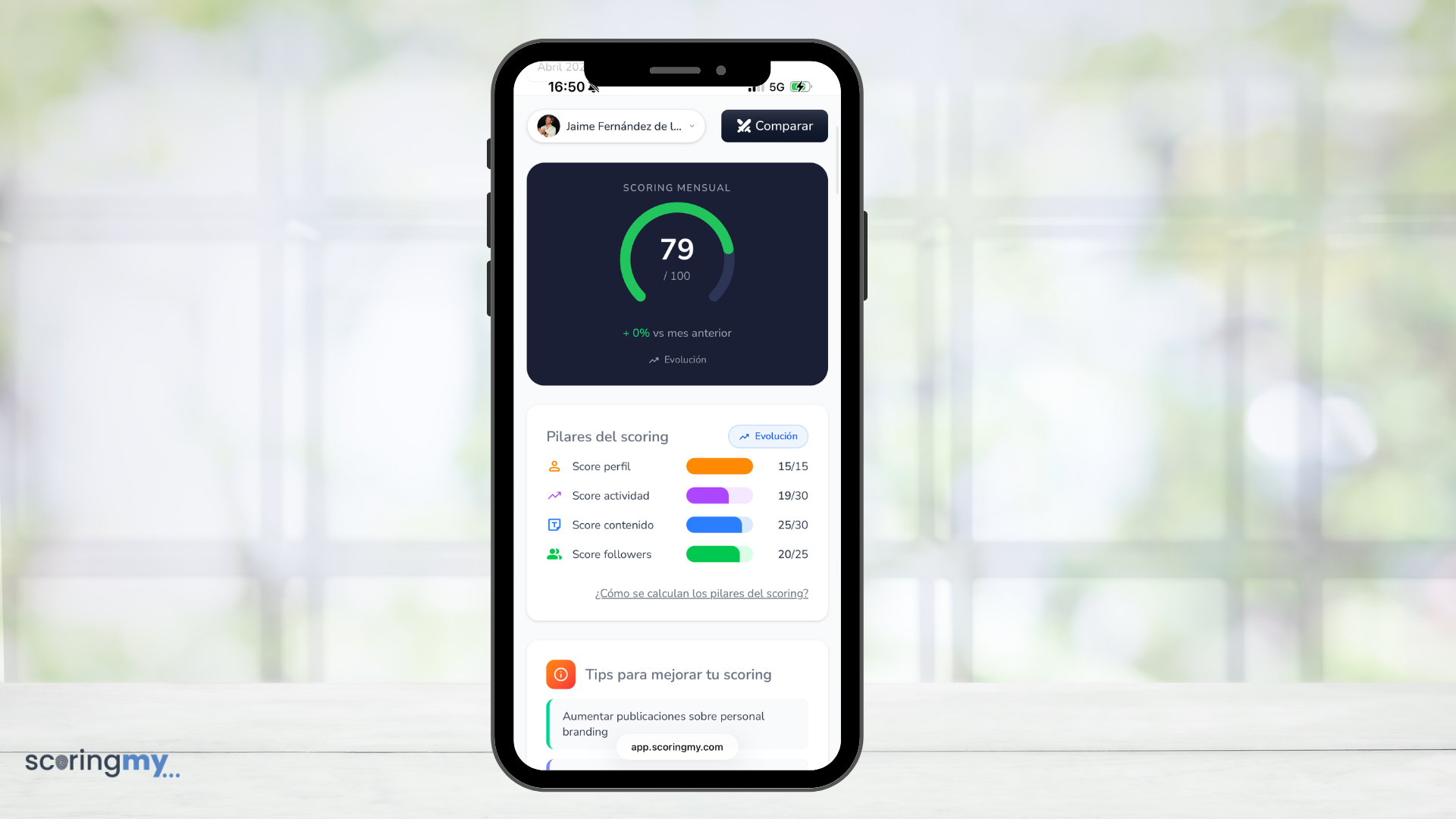
The platform makes it possible to analyze, month by month, the digital presence of every professional at a company on LinkedIn, without asking for usernames or passwords, working from public information. That point is a real differentiator, because it removes friction and allows you to work with the whole company, not just a small voluntary sample.
From there, Scoringmy helps measure individual and collective scoring, activity, engagement, aggregate followers, economic impact, monthly evolution, market comparisons, and competitor benchmarking.
And it doesn’t stop at the big picture. It segments the data by department, detects potential ambassadors, analyzes competitors’ executives, and reviews what percentage of posts falls within the company’s red lines or strategic communication territories.
That’s key for employer branding. Because it isn’t just about getting people to post. It’s about communication reinforcing what the company wants to position, and avoiding deviations that create noise, inconsistency, or risk.
From that measurement, Scoringmy activates. It does so with personalized challenges, AI tools, weekly tips, practical training, content adapted to each professional’s style, and the ability to turn corporate content into personal pieces without losing strategic consistency.
That approach fits today’s market well. People don’t want to sound like a brochure. They want to post in their own voice. And companies don’t want to lose control of the framework. They want to scale presence without opening up reputational risk.
Scoringmy works precisely at that balance point.
What the sector data says in Spain
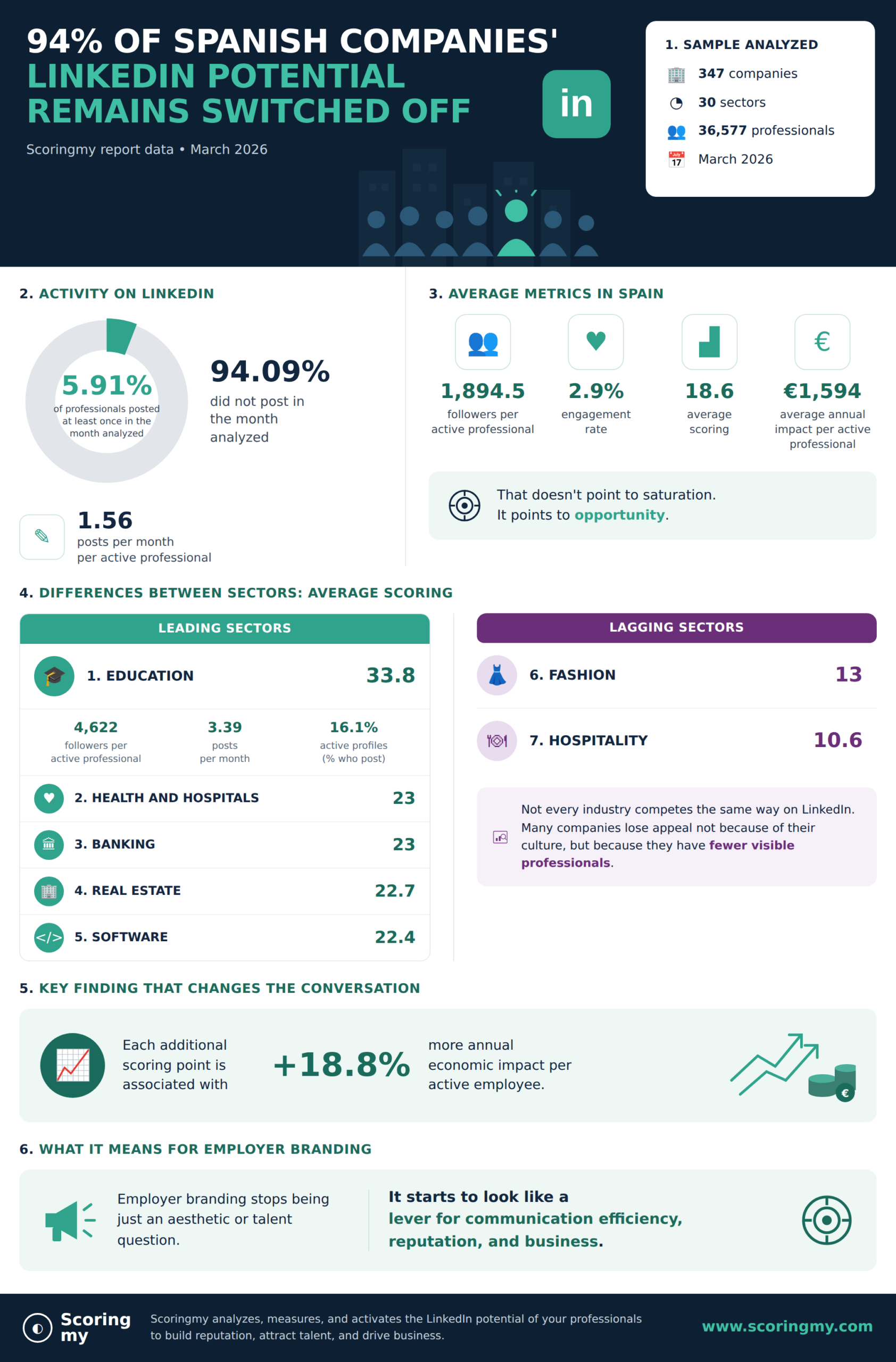
Scoringmy’s own project data helps ground this conversation. In our report on the LinkedIn presence of professionals in Spain, based on 347 companies, 30 sectors, and 36,577 professionals analyzed in March 2026, the overall average leads to a clear conclusion: only 5.91% of professionals posted at least once during the month analyzed.
In other words, more than 94% of companies’ visible potential remains switched off.
The overall average observed in Spain was 1.56 posts per month per active professional, 1,894.5 followers per active professional, an engagement rate of 2.9%, an average scoring of 18.6, and an average annual impact of €1,594 per active professional.
That doesn’t point to saturation. It points to opportunity.
When we look at sectors, the differences are even more interesting. Education clearly leads in digital maturity with an average scoring of 33.8, 4,622 followers per active professional, 3.39 posts per month, and 16.1% of profiles active. Health and Hospitals reaches a scoring of 23. Banking, 23. Software, 22.4. Real Estate, 22.7. Fashion, by contrast, drops to 13 and Hospitality to 10.6.
What does this mean for employer branding? That not every industry competes the same way on LinkedIn. And that many companies are losing appeal not because their culture is worse, but because they have fewer visible professionals.
There’s also a particularly powerful data point: the internal correlation analysis carried out across 346 companies concludes that each additional scoring point is associated with 18.8% more annual economic impact per active employee.
That pattern changes the conversation. Employer branding stops being just an aesthetic or talent question. It starts to look like a lever for communication efficiency, reputation, and business.
The role of executives and managers
If there’s one critical piece in this strategy, it’s visible leadership.
Data from the LinkedIn Leaders Ranking & Insights 2025 report shows that in Spain only 2.2% of profiles post each month. It also shows that executives are still far from their maximum potential on LinkedIn.
Communications directors lead the average scoring with 42.2 points out of 100, while the Spanish average sits at 15.2. No executive group exceeds 50% of total potential.
This matters a great deal for employer branding. A visible executive doesn’t just improve their own reputation. They also send signals about the company’s culture, clarity of vision, and digital maturity.
The same study offers another useful lesson: personal content connects better than purely corporate content. Personal posts reach an ER of 2.37%, above corporate content, and value-adding formats build long-term brand equity even when they aren’t always the ones that generate the most likes.
The conclusion is very practical. To strengthen employer branding, executives shouldn’t limit themselves to sharing company messages. They need to build their own presence, with judgment, warmth, and consistency.
And that too can be measured, compared, and activated with Scoringmy.
Common employer branding mistakes on LinkedIn
The first mistake is thinking everything can be solved with a content strategy for the corporate page.
The second mistake is believing that publishing corporate messages on personal profiles already amounts to activating ambassadors. It doesn’t. It only amplifies if the professional feels that content represents them.
The third is not measuring. Without measurement there’s no focus, no prioritization, and no serious way to demonstrate return.
The fourth is treating every profile the same. A CEO, a manager, a sales engineer, and someone in HR don’t communicate the same way. Each group needs different frameworks, challenges, and tools.
The fifth is forgetting the competition. A company doesn’t compete for talent in the abstract. It competes against other brands that also occupy space on LinkedIn. If you don’t compare your presence with the market, you don’t know whether you’re actually making progress.
What a company should do starting now
The right sequence isn’t to start posting more. It’s to start measuring better.
First, analyze the real activity across the entire organization. Second, identify active professionals and potential ambassadors. Third, segment by department and understand where the opportunities are. Fourth, set improvement targets. Fifth, activate with training, AI, challenges, and content adapted to each profile’s style. Sixth, measure again and compare the evolution.
That approach turns employer branding into a system, not a campaign.
And that’s where Scoringmy can become a clear partner for marketing, communications, and social media managers at B2B companies. Because it makes possible something almost nobody could do well until recently: measuring and activating the professional communication of an entire company on LinkedIn, in detail, without friction, and with a business focus.
The conclusion is direct. Your corporate page still matters, but it’s no longer enough. Real employer branding is built from the sum of your professionals’ voices.
If those voices don’t exist, your employer brand is weak. If they exist but can’t be measured, your strategy is flying blind. And if they’re measured, activated, and developed methodically, your company gains an advantage that’s hard to copy.
That’s what Scoringmy offers: turning your professionals’ presence into a measurable lever to attract talent, strengthen reputation, and generate more impact from LinkedIn.
Want to see it with your company’s and your competitors’ data? Book a Scoringmy demo and find out who’s communicating, how much impact they generate, and where the real opportunity for improvement lies.


