
How to Measure Whether Your Employer Branding Is Working on LinkedIn

Many companies believe their employer branding is working because they post, get a few likes, or see more movement on LinkedIn. The problem is that this isn’t enough.
If you can’t measure what’s happening, who’s driving it, and what real impact it generates, you don’t have a strategy. You have activity.
And that difference matters a great deal. Because an employer brand doesn’t improve through intuition. It improves when you know which profiles are driving the company’s visibility, which content reinforces your positioning, which departments have gone quiet, and how all of that evolves month by month.
That’s where Scoringmy changes the conversation. It doesn’t stop at helping you post. It lets you measure, visualize, and activate your company’s professional presence on LinkedIn, turning it into a real lever for talent attraction, reputation, and business.
Table of contents
- Why posting alone isn’t employer branding
- What it really means for your employer branding to work
- The KPIs you actually should be measuring
- Key metrics table and how to interpret them
- Common mistakes when measuring employer branding
- What Scoringmy measures and why it matters
- Why benchmarking against competitors changes the reading
- How to measure alignment, red lines, and strategic territories
- How to connect employer branding with economic impact
- What a useful dashboard should look like
- What to do from here
Why posting alone isn’t employer branding
Posting on LinkedIn isn’t the same as building an employer brand. You can post frequently and still not be improving your appeal as a company.
The reason is simple. Employer branding isn’t volume. It’s perception. And perception depends on many factors at once: employee visibility, profile quality, type of content, consistency, visible leadership, a human tone, alignment with the company, and the ability to build trust.
That’s why measuring only impressions or engagement on a corporate page leaves out almost everything that matters. The market doesn’t judge a company by its official account alone. It judges the company by the sum of the signals its professionals send.
If you want to know whether your employer branding is working, you need to see the whole picture. Not just one corner of the frame.
What it really means for your employer branding to work
Employer branding that works isn’t the kind that gets the most internal applause. It’s the kind that gets the market to see the company as attractive, serious, active, and full of professionals with something to say.
You can tell when there are more visible profiles, more relevant activity, more consistency between company and employees, and more signals of real culture.
You can also tell when the company stops relying on the corporate page alone and starts projecting itself through different voices: executives, managers, technical profiles, HR, sales, and internal ambassadors.
And above all, you can tell when you’re able to track evolution. If this month you have more active professionals, a higher scoring, a better content mix, fewer red lines, more strategic territories, and more economic impact than six months ago, then you can genuinely say you’re improving.
Without measurable evolution, there’s no real improvement. There’s just a feeling of movement.

The KPIs you actually should be measuring
The usual temptation is to settle for two or three indicators. Followers, likes, and reach. But a serious employer branding strategy needs a much deeper reading.
These are the layers that really matter.
1. Company-wide scoring
This gives you a synthetic view of how mature the organization’s professional presence on LinkedIn is.
It doesn’t replace the other metrics, but it helps you see whether the overall baseline is improving or declining. Done well, scoring lets you compare months, departments, and also competitors.
2. % of active professionals
This is a critical metric. It tells you how much of the company is actually visible on LinkedIn.
An employer brand isn’t built on two strong profiles while everyone else stays silent. It’s built when internal talent starts occupying space consistently.
3. Posting frequency
Not to reward quantity, but to understand whether the activity is sustainable. Posting once a quarter leaves no trace. Posting well and consistently does.
4. Engagement rate
It doesn’t just measure reaction. It measures the relative connection between content and audience.
It’s useful, but it should always be read alongside followers, format, content type, and consistency. A high ER in isolation can mislead.
5. Aggregate followers and followers per active employee
These help you understand the company’s distribution potential through its people.
The more your professionals’ qualified networks grow, the greater the company’s ability to reinforce brand, authority, and talent attraction through real profiles.
6. % of original posts vs. reposts
This figure matters a lot. A program full of reposts can look active, but it projects less authenticity.
When original content grows, so does the company’s ability to appear alive, expert, and human.
7. % of company mentions
This is a very useful metric for understanding the link to the brand. Neither too low nor artificially high.
The point isn’t to force mentions. It’s to see whether the company appears naturally woven into its professionals’ conversations.
8. Content format and type
Knowing how much gets posted isn’t enough. You need to know what gets posted.
Text, image, video, article, document. Informational, personal, corporate, or educational. The mix says a lot about how the company’s presence is being built.
9. % of red lines and % of strategic territories
This is one of the most differentiating layers. Measuring employer branding isn’t just measuring activity. It’s measuring whether that activity is aligned with what the company wants to reinforce.
A mature organization doesn’t censor its employees. It gives them a framework. And then it measures whether they’re using it well.
10. Economic impact
This KPI completely changes the conversation with leadership. Because it connects professionals’ organic activity with an estimate of the economic value generated.
When employer branding can also be translated into impact, it stops looking like a soft project and becomes far more strategic.
Key metrics table and how to interpret them
| KPI | What it measures | Why it matters | Risk of misreading it |
|---|---|---|---|
| Company scoring | Overall maturity of LinkedIn presence | Lets you track evolution and compare | Using it without digging into the detail |
| % active professionals | How much of the workforce is visible | Indicates the program’s real traction | Believing a handful of profiles is enough |
| Posts per active employee | Production rhythm | Helps you see consistency | Confusing quantity with quality |
| ER% | Relative connection between content and audience | Measures the market’s response | Not cross-checking it with followers and format |
| Aggregate followers | Total distribution capacity | Indicates the company’s potential reach | Looking at it without segmenting by active profiles |
| % original posts | Level of original content | Reinforces authenticity | Penalizing every repost without context |
| % company mentions | Natural brand presence in posts | Measures the link to the company | Forcing mentions and making it artificial |
| % red lines | Misalignment or risk | Protects reputation and framework | Using it to punish rather than to teach |
| % strategic territories | Alignment with priority topics | Reinforces the desired positioning | Confusing variety with dispersion |
| Economic impact | Estimated value generated | Brings employer branding closer to business | Reading it without evolution or benchmark |
Common mistakes when measuring employer branding
The first mistake is measuring only the corporate page. That leaves out the real engine of professional visibility.
The second is using isolated metrics without context. High engagement can sound good, but it doesn’t mean the same thing on a small profile, a large one, or at a company with few active people.
The third is not segmenting. If you don’t break things down by department, ambassadors, executives, or specific groups, you won’t know where the improvement opportunities are.
The fourth is not comparing against competitors. You can grow and still be behind the market. Improving without an external reference is an elegant way of flying blind.
The fifth is turning measurement into surveillance. If someone steps outside the framework, the right response isn’t to punish. It’s to teach, adjust, and re-activate.
What Scoringmy measures and why it matters
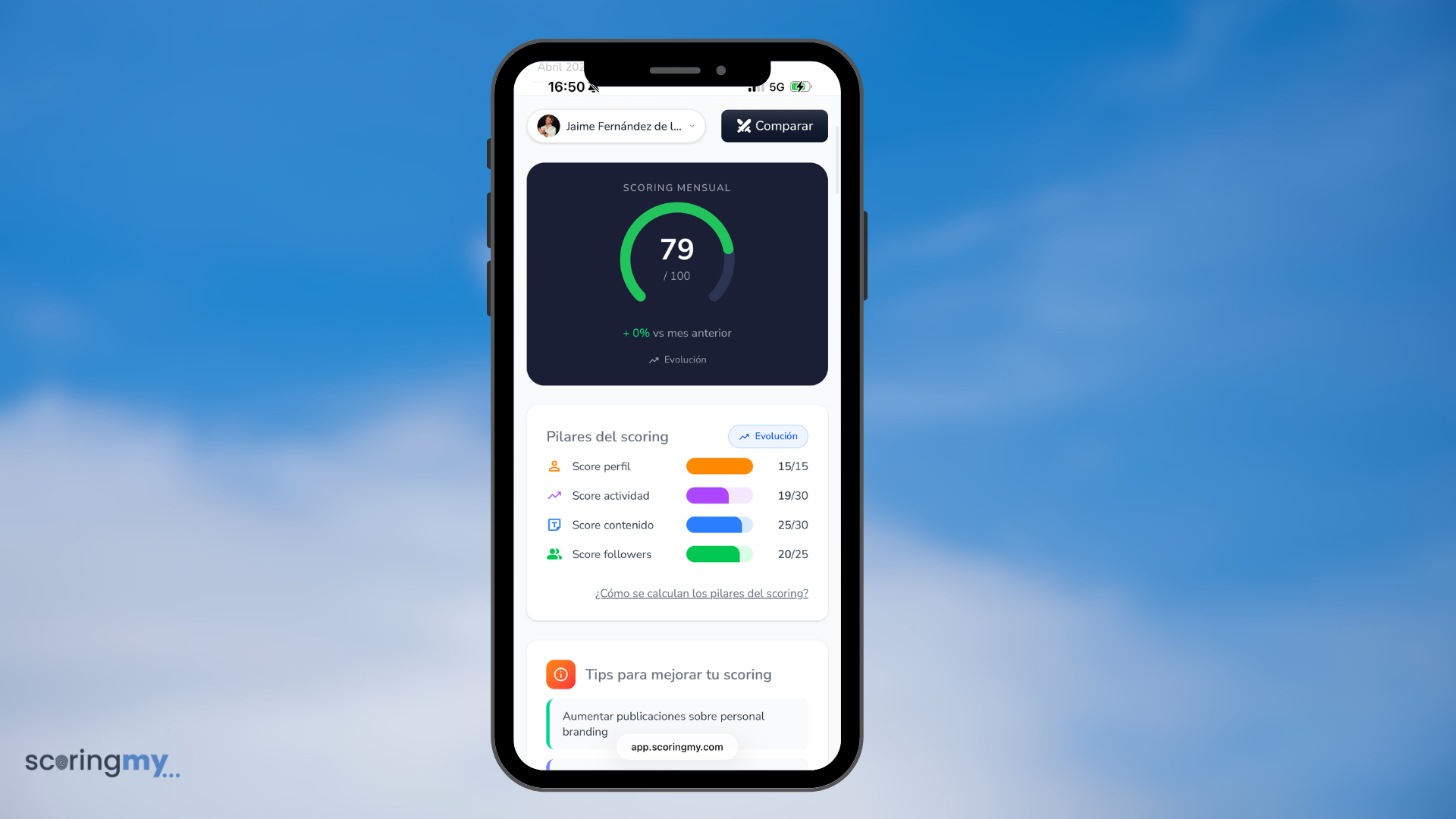
One of Scoringmy’s strengths is that it doesn’t stop at surface-level analytics. The tool is designed to read the company across several layers at once.
In the company view, it measures overall scoring, monthly evolution, employees analyzed, percentage active, aggregate followers, monthly and annual economic impact, general profile optimization data, and overall content behavior.
In the individual view, it goes into the detail of each professional: scoring, scoring pillars, internal and external ranking, monthly impact, annual projection, profile status, impressions, original posts, engagement rate, followers, content formats, content types, ER by type, original-to-repost ratio, company mentions, red lines, communication territories, and personalized goals.
And in the external ranking view, it lets you compare your own profiles against external benchmarks or competitors. That gives a far more powerful reading of the market and helps you escape self-referential analysis.
On top of that, the tool doesn’t stop at the data. It connects it with weekly challenges, AI tools, training, tutorials, and personal and corporate content generation to drive improvement.
That combination is valuable. Many solutions either measure or make content easier. Scoringmy joins the two layers: analytics and activation.
Why benchmarking against competitors changes the reading
A company can feel like it’s making progress because internally it sees more movement. But until it compares that against its market, it doesn’t know whether it’s actually improving.
External benchmarking avoids that trap.
It lets you see whether your executives are close to or far from the profiles leading their sector. Whether your ambassadors post less often. Whether they generate less impact. Whether they mention the company better or worse. Whether their scoring is at the average or clearly below it.
And that’s not just useful for diagnosis. It’s useful for setting smarter goals.
| Without benchmark | With benchmark |
|---|---|
| “It seems like we’re improving” | “We’re up 12% in scoring, but still below the sector leaders” |
| “We have active profiles” | “We have fewer active profiles than our direct competitors” |
| “Our content works” | “It works, but it generates less economic impact than comparable profiles” |
| “Our CEO posts” | “They post, but they’re far behind benchmark CEOs in scoring and visibility” |
Scoringmy handles this part well, because it lets you cross-reference company, ambassadors, executives, and competitors within a single analytical logic.
How to measure alignment, red lines, and strategic territories
This is one of the most sophisticated layers, and at the same time one of the most useful for employer branding.
Many companies measure activity, but they don’t measure alignment. And that’s where a central part of the value slips away.
If you want to build a solid employer brand, you need your professionals’ activity to keep reinforcing certain themes. Innovation, culture, leadership, talent, impact, technical expertise, or whichever territories matter to your brand.
You also need to spot when someone steps outside the framework. Not to scold them, but to correct course in time and prevent fear down the line.
Scoringmy lets you measure both layers. On one hand, the percentage of content aligned with strategic territories. On the other, the percentage of posts that cross red lines.
That changes how you manage things. You stop saying “we think we’re doing well” and start saying “92% of the content is in priority territories, but we need to bring red lines down from 5.3% to our defined target.”
| Layer | What it answers | What it’s for |
|---|---|---|
| Strategic territories | Are we reinforcing the right themes? | Consolidating positioning |
| Red lines | Where is there risk or misalignment? | Correcting without blocking participation |
| % company mentions | Does the brand appear woven into the conversation? | Connecting individual and corporate visibility |
| % original posts | Is there authenticity or too much replication? | Reinforcing personal voice |
How to connect employer branding with economic impact
One of employer branding’s biggest problems is that it’s often described as important but hard to ground in business terms.
Scoringmy helps solve exactly that, through its measurement of estimated economic impact, both monthly and annual, at company and individual level.
This doesn’t mean reducing the whole strategy to money. It means being able to talk to leadership in a more complete language.
When you can show the evolution of active professionals, scoring, territories, visibility, benchmarking, and estimated economic impact on top of all that, the project stops looking like a tactical LinkedIn initiative. It starts to be seen as a cross-functional lever.
What’s more, Scoringmy’s own internal analysis across 346 companies found a clear relationship: each additional scoring point is associated with 18.8% more annual economic impact per active employee.
That relationship is powerful because it reinforces a key idea: improving the maturity of your professional presence doesn’t just organize communication. It can also increase its estimated value.
What a useful dashboard should look like
If you want to measure employer branding for real, you need a dashboard that lets you read three planes at once: current situation, evolution, and target.
That means leaving the pretty report behind and entering an operational logic.
| Block | What it should include |
|---|---|
| Current state | Scoring, active profiles, followers, posts, ER, impact |
| Evolution | Month-on-month comparison and trend |
| Content quality | Formats, content types, original vs. repost, company mentions |
| Alignment | Strategic territories and red lines |
| Benchmark | Comparison with market and competitors |
| Goals | Target per KPI and actual progress |
| Activation | Challenges, training, AI, and individual follow-up |
That approach lines up with what Scoringmy already offers in its company, individual, ranking, and goals views. You don’t just see where you are. You see what you should move and how to improve it.
What to do from here
If you want to know whether your employer branding is working on LinkedIn, the question isn’t how many likes you get. The question is whether your company is increasing its professional presence, its strategic alignment, its ability to attract talent, and its visibility relative to the market.
That calls for a more serious reading. A more complete one. A more useful one for making decisions.
You need to know how many profiles are active, how they’re evolving, what content they post, what impact they generate, how much original content there is, how much of it connects to the company, which red lines are showing up, and how far behind your competitors you are.
And then you need to activate. With challenges, AI tools, training, content adapted to each person’s style, and a follow-up system that turns data into improvement.
That’s exactly what Scoringmy makes possible: measure first, activate second, and prove with data whether your employer branding on LinkedIn is working or not.
Book a demo and find out how to measure the real impact of your professionals’ presence on LinkedIn.


