
LinkedIn Telco Spain Report 2026: How the Sector’s Professionals Communicate

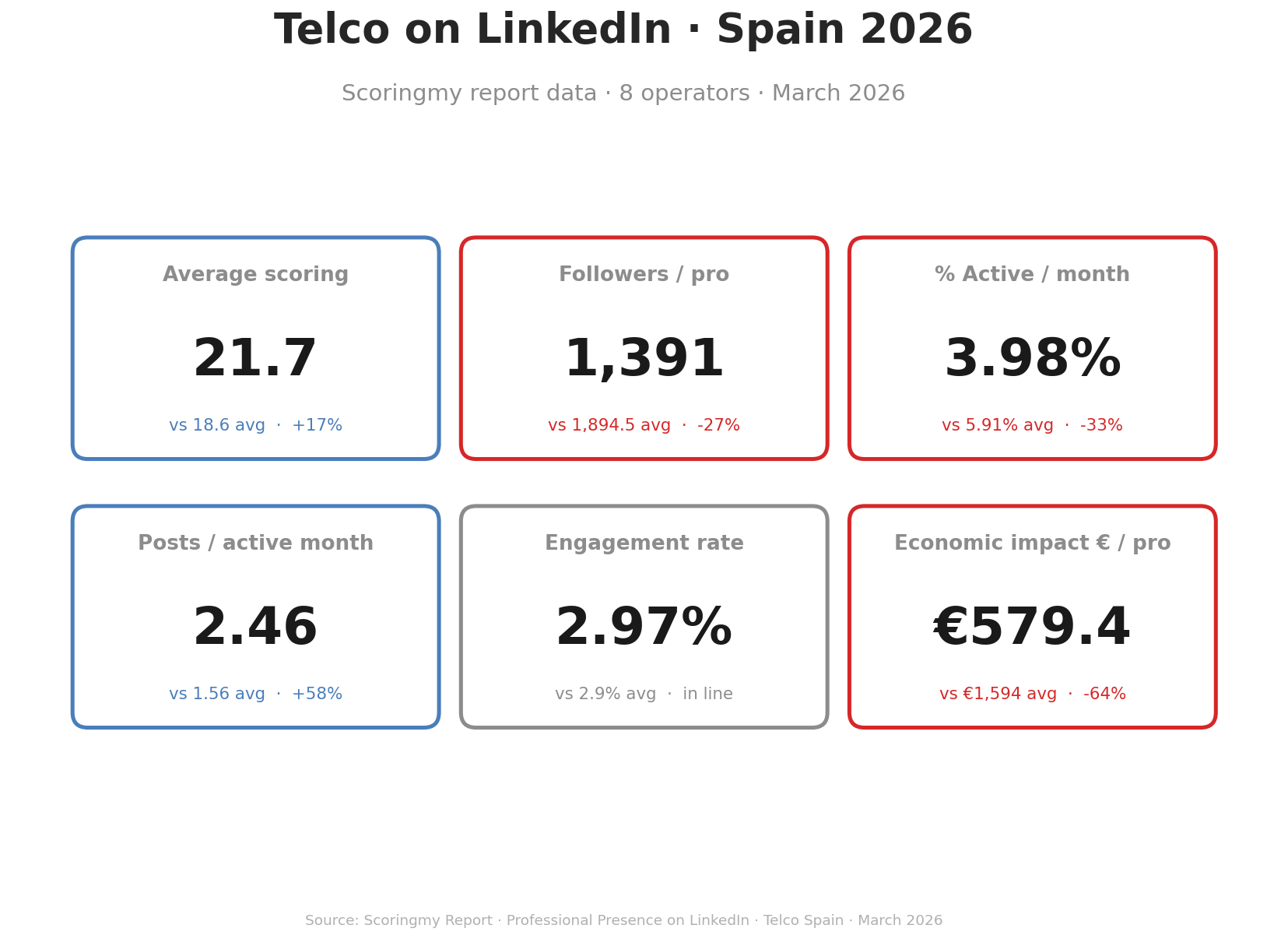
The Telco sector writes well on LinkedIn. In fact, it writes more than almost any other sector in Spain. And yet its impact falls short. This is the paradox we found when analyzing the LinkedIn presence of telecommunications professionals: a sector with a publishing habit, with above-average content, but with a follower network too small for that effort to translate into real reach.
At Scoringmy we analyzed eight operators active in the Spanish market and measured their presence against the same four pillars we apply to every other sector. The result paints a picture of a sector that is mature in what depends on each professional—the habit of posting—and weak in what gets built over time: the audience.
The number that sums up the situation is this: only 3.98% of the sector’s professionals post at least once a month. Nearly 96% of Spanish telecommunications’ visible potential remains switched off.
Table of contents
- What we analyzed and how
- Telco vs. the Spanish average
- The scoring is measured across four pillars
- The 8 operators included in the analysis
- Who leads in each variable
- Economic impact: plenty of content, little reach
- Three strategic takeaways for Telco
- How to download the full report
- Frequently asked questions
What we analyzed and how
This report is part of a broader study on the LinkedIn presence of Spanish professionals. In total, we analyzed 347 companies, 28 sectors, and 36,577 professionals, with data collected in March 2026.
We work exclusively with public LinkedIn information. We don’t scrape, we don’t automate behavior, and we don’t use users’ credentials. For the Telco sector we measured six key indicators: average scoring, followers per active professional, percentage of active professionals, original posts published per month, engagement rate, and estimated economic impact per professional.
Telco vs. the Spanish average
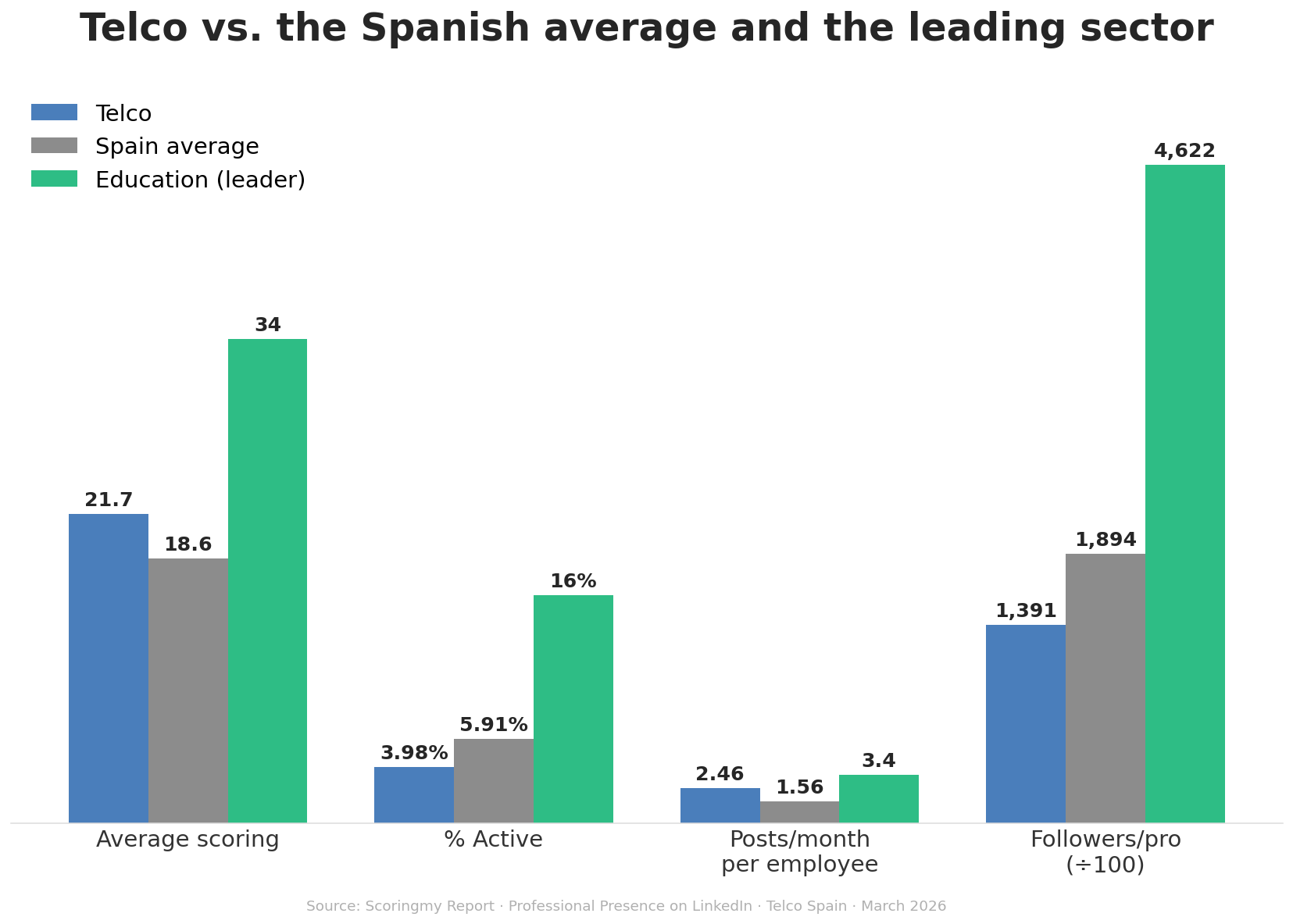
Compared with the national average, the Telco sector shows a clearly polarized profile. Where it depends on the individual professional, it wins. Where it depends on accumulated audience, it loses.
The sector’s average scoring is 21.7 out of 100, 17% above the Spanish average of 18.6. In posting frequency the gap is even wider: 2.46 original posts per month per active professional, versus 1.56 for the average. That’s 58% more posts. The engagement rate, 2.97%, stays essentially in line with the national average of 2.9%.
The flip side shows up in two variables. The first is how many people post: only 3.98% of professionals are active, compared with 5.91% for the average. The second, and more decisive, is network size: 1,391 followers per active professional, 27% below the national average of 1,894.5. The sector posts more, but to fewer people.
The scoring is measured across four pillars
Scoringmy’s scoring is calculated out of 100 points, split across four pillars that reflect both the quality of a professional’s presence and their actual activity:
- Profile (15 points). Profile quality: photo, headline, optimized URL, “about” section, experience.
- Followers (25 points). Follower volume. The more followers, the greater the potential impact of each post.
- Activity (30 points). Posting frequency and the engagement rate achieved through interactions.
- Content (30 points). The type and quality of the content: that it isn’t a repost, that it mentions the company to the right degree, and that it adds value.
The Telco case illustrates why these are measured separately. The sector scores high on the Activity pillar, thanks to its posting frequency. But the Followers pillar, worth 25 points, penalizes it: that’s precisely where the sector has the most room to improve.
The 8 operators included in the analysis
The Telco sector analysis includes eight operators present in the Spanish market: BT, DIGI España, Euskaltel, Lowi, MasOrange, Pepephone, Telefónica, and Vodafone. Here, large groups with a long-standing presence sit alongside the more agile operators born in the digital era, which makes it possible to compare very different communication cultures within a single sector.
Who leads in each variable
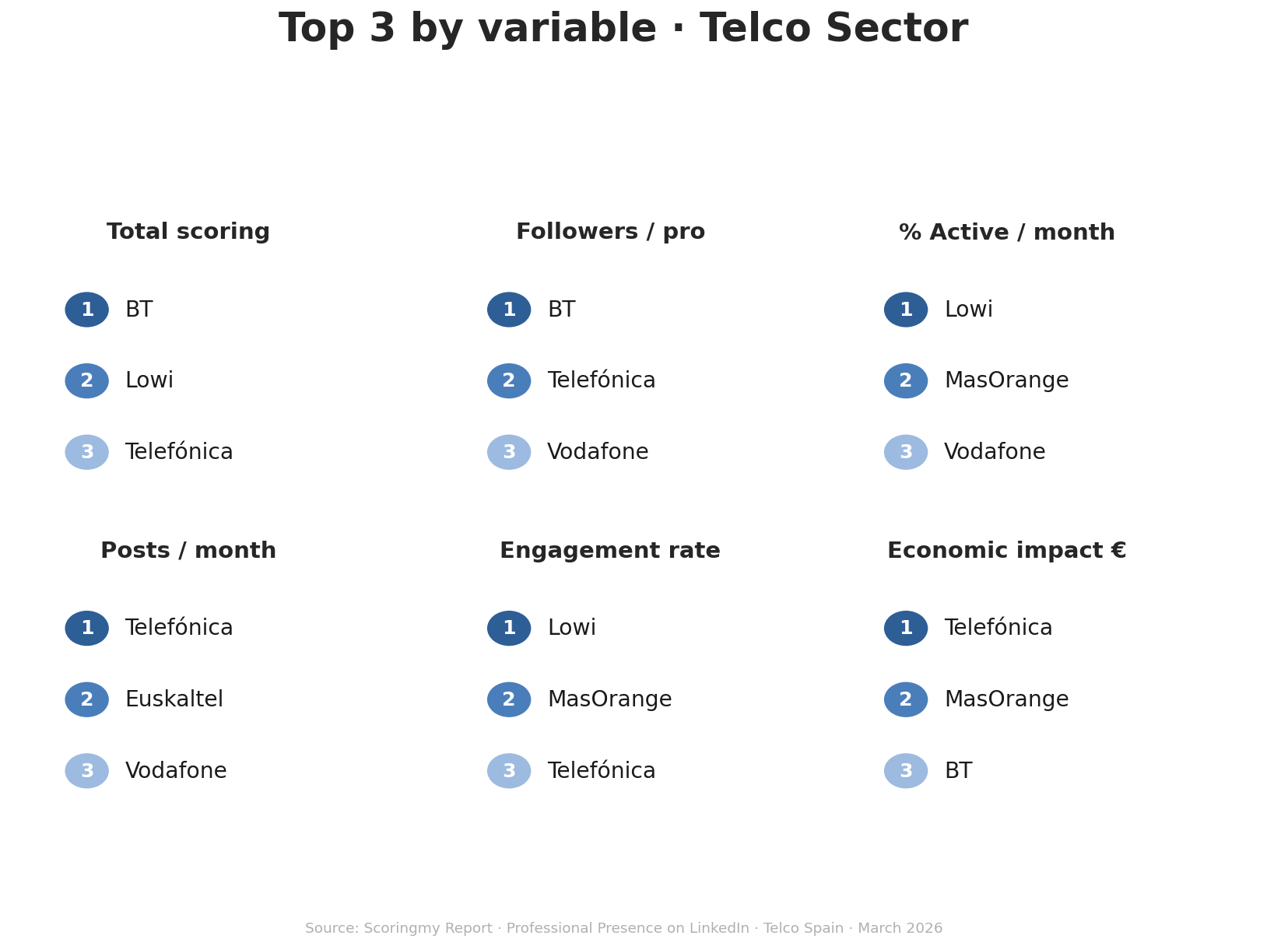
Within the sector, leadership is split between large and small operators in a revealing way:
- BT leads the sector in total scoring and in followers per active professional. It’s the operator with the most solid presence and the widest audience per professional.
- Lowi leads in percentage of active professionals and in engagement rate. Its community is smaller, but more participative and with a higher share of people posting.
- Telefónica leads in original posts published per month and in economic impact per professional, backed by the size of its workforce.
The split is no accident. Digital and low-cost operators like Lowi mobilize a larger share of their people; the big groups contribute absolute volume of content and audience. Neither has managed to combine the two yet.
Economic impact: plenty of content, little reach
The estimated economic impact per professional in the Telco sector is €579.4 per year, far below the national average of €1,594. That’s a 64% gap, and it’s the direct consequence of the paradox running through the entire report.
Impact doesn’t depend only on how much you post, but on how many people you reach. A sector that posts 58% more than the average but has a network 27% smaller ends up scattering its effort. The content is there, the consistency is there, but the loudspeaker—the audience that amplifies every message—is too small.
Translated into strategy: the Telco sector doesn’t need to convince its people to post more. They already do. It needs to help them build an audience, because that’s where the return is being lost.
Three strategic takeaways for Telco
1. The problem isn’t the content, it’s the reach. Few sectors post with Telco’s consistency. The growth lever isn’t producing more, but growing each professional’s follower network so that content travels further.
2. The number of active professionals is the real ceiling. With only 3.98% of professionals posting, the sector leans on very few people. Activating even part of the remaining 96% would multiply the sector’s presence without anyone having to post more than they already do.
3. The small players are showing the way. Operators like Lowi prove you can have a more participative community and a higher share of active people. It’s a replicable model for the big groups, which have the volume but not always the participation.
How to download the full report
This analysis is a summary. The full Telco sector report includes all the rankings, operator-by-operator data, the Top 3 breakdown for each variable, and comparisons with every other sector in Spain. It’s freely available at no cost.
Download the LinkedIn Telco Spain 2026 report
Frequently asked questions
What is the Telco sector’s average LinkedIn scoring?
The Telco sector has an average scoring of 21.7 out of 100, 17% above the Spanish national average (18.6). That’s above-average digital maturity, though far from the leader, Education, which reaches 34 points.
How many Telco professionals post on LinkedIn?
Only 3.98% of Telco professionals post at least once a month on LinkedIn, below the national average of 5.91%. In other words, more than 96% of the sector’s visible potential remains inactive.
Do active Telco professionals post a lot?
Yes. Active Telco professionals publish an average of 2.46 original posts per month, 58% more than the Spanish average (1.56). It’s the second most active sector in Spain by posting frequency, tied with Health and Hospitals and behind only Education.
What is the Telco sector’s weak point on LinkedIn?
Reach. Each active Telco professional has an average of 1,391 followers, 27% below the national average (1,894.5). The sector posts frequently and with good quality, but reaches a network that’s too small, which limits its economic impact per professional to €579.4 per year.
Which Telco companies were analyzed?
The report analyzes eight operators present in Spain: BT, DIGI España, Euskaltel, Lowi, MasOrange, Pepephone, Telefónica, and Vodafone.
How is Scoringmy’s scoring calculated?
The scoring is measured out of 100 points split across four pillars: Profile (15 points), Followers (25 points), Activity (30 points), and Content (30 points). Only public LinkedIn information is analyzed, with no scraping or use of credentials.


